

In speaking with the faithful We have observed much confusion in regard to the nature of the vocation to the clerical state. By clerical state is meant -- all the orders from tonsure to the episcopacy.
We contrast the lay state with the clerical state with an example: there are two stories to the house, called Catholic Church. The lower level contains all those who are not in the clerical state, and the upper level contains those who are in the clerical state.
The only way that one can enter the lower level is by the baptism of water, which is received with the intention of becoming a Catholic. For the infant generally, that intention is supplied by the parents. Adults receiving the baptism of water must desire to become Catholics when they receive the baptism of water. Here We will not deal with the baptisms of desire and blood, for both of them put one “within” the Church without making them full Catholics with the ability to receive the other sacraments.
Just how does one enter the clerical state? No one can enter the clerical state with his own power. He must be brought into it by a bishop or by the Pope himself. The cleric will always be subject either to a bishop, a religious superior, or the Pope. The chain of command is this: The Pope is over every bishop, and the bishop is over his priests, including all those in Holy Orders of whatever level. Religious priests are subject to the Pope by way of their superiors who in turn are subject to the Pope.
Just what is a vocation to the priesthood (including all the Orders below it)? We must make a distinction. A calling that God puts into the heart of men to become priests is called a vocation in a general way. However, the real calling always comes from the Church. God never calls a man to the priesthood independently of the call of the Church. When one is ordained a priest, for example, he stands in the sanctuary and waits for the call of a master of ceremonies. When his name is called he says, “Ad sum.” That is equivalent to saying “Here.” Then he steps forward, and that action plus his “Ad sum” shows that he accepts the call (vocation) of the Church to be ordained a priest.
Once the candidate makes that step, the bishop asks the public if they have any reasons why the candidate is not worthy to be a priest. If all are silent the bishop says, “Deo gratias.” That is the beginning and the end of the vocation to the priesthood. Once the man is ordained, he makes a vow of obedience to a bishop or religious superior, something that was determined beforehand.
We will put it another way. If no bishop on earth or religious superior on earth will accept a man to be his subject as a priest the man can never become a priest. Furthermore, once he is a priest he remains subject to the bishop or religious superior as long as he lives. If the cleric should become unfaithful to his vow, the bishop or religious superior will remove him from the clerical state. The mark of the priesthood can never be taken from him, but his position as a cleric in the Church can be taken from him. We say that he has been reduced to the lay state. It is not likely that he will be dispensed from his vow of celibacy. He will have to make his living by some ordinary job: a butcher, a baker or a candle stick maker.
Before one is accepted into the clerical state, the candidate must show that he is worthy. He must have normal intelligence and common sense. He must have normal holiness with a desire to live for God and the salvation of souls. Quite generally, the same qualifications are required of those entering the Religious state where they, Brothers and Sisters remain outside of the clerical state.
When a non-Catholic “cleric,” that is, one who has valid or invalid Orders (received outside the Catholic Church), comes to the Church, his first step is to enter the Church as a layman. Before the conversion or after the conversion his worthiness to function in Church as a cleric must be judged by the Church. An example would be: a policeman from France goes to England to be a citizen and policeman there. His qualification as a citizen comes first, and then he is judged ready or not ready (yet) to serve on the police force in England.
Since those in the clerical state and Religious state must give a service to the Catholic faithful, it is also necessary that they have normal health and be without deformities that would hamper their work. All this is nothing more than an application of common sense inspired by prudence, wisdom and counsel.
Catholics always pray that God will send worthy laborers into the clerical state. It is normal that each area supply its own priest and not perpetually depend on missionaries from foreign lands. All the members of the Mystical Body must work for the good of the whole Mystical Body.
Given in Spokane, Washington, USA
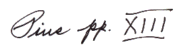
Pius, pp. XIII
October 29, l999

Top of Page |
Pope's
Homepage |
 Email
Email |
 |