

How is man Justified?
Source Material
The main source material for this treatise is provided by courtesy of Eternal Word Television Network EWTNews. It is “Annex to Common Statement Explaining Terms of Joint Declaration.”
Background
On October 31, 1999, a meeting was conducted between the Vatican and the
Lutheran Federation in an attempt to bring unity of doctrine between the
Novus Ordo Catholic Church and the Lutheran religion. While this
meeting and unity has no bearing on the true Catholic Church, it does raise
several items of consideration for those who believe they are Catholic
and those who claim to be Lutheran.
The Doctrine of Justification
On page nine of the Vatican-Lutheran Accord, number 41, it states:“Thus the doctrinal condemnations of the 16th century, in so far as they relate to the doctrine of justification, appear in a new light: ‘The teachings of the Lutheran churches presented in this Declaration does not fall under the condemnations from the Council of Trent. The condemnations of the Lutheran Confessions do not apply to the teachings of the Roman Catholic Church presented in this Declaration.”
The Effect
The effect of this statement is that the argumentation for the present Joint Declaration is detached from history, in that what was condemned by the Catholic Church of old no longer exists. Also the Lutherans find nothing in the Church today that they condemned at the time of Luther. They pretend that there is something entirely new in this discussion.In number 40 the statement is made:
“Therefore the Lutheran and the Catholic explications (sic) of justification are in their difference open to one another and do not destroy the consensus regarding the basic truths.”Hence, logic would urge that there really is no serious reason for going on with this otherwise serious discussion, and this treatise could end right here.
Compare to the Teaching of the true Catholic Church
The cause of truth would not be well-served if the public were left without the clear teaching of the true Catholic Church under all the Popes of history and today under Pope Pius XIII. What is seen in Rome, the Vatican today, is a mush of total confusion. What was revealed (in a private revelation) in La Salette in 1846 and approved by Pius IX and Leo XIII has come true:“Rome will lose the faith and become the seat of the antichrist.”In order to facilitate further studies of this matter, many of the sources of Catholic doctrine are quoted. One available source is Canons and Decrees of the Council of Trent by Rev. H. J. Schroeder, O.P. from TAN Books & Publishers, P.O. Box 424, Rockford, IL 61105. The imprimatur date is 1941. The book can also be ordered from St. Michael’s Catholic Books and Gifts, (815) 942-8303 [fax –942-1730].
After the Lutherans and the general Protestant world messed up things in religion, the Council of Trent was convened, and it made many wonderful statements of doctrine. The heading of Chapter IV of the sixth session of the Council of Trent reads as follows:
What happens in justification is this. A soul which does not possess sanctifying grace by reason of original sin or mortal sin, moves over (changes) to the condition of soul where it is transformed into a new creature, made so by the reception of sanctifying grace.A Brief Description of the Justification of the Sinner and its Mode in the State of Grace In which words is given a brief description of justification of the sinner, as being a translation from that state in which man is born a child of the first Adam, to the state of grace and of the adoption of the sons of God through the second Adam, Jesus Christ, our Savior. This translation however cannot, since the promulgation of the Gospel, be effected except through the laver of regeneration or its desire, as it is written; Unless a man be born again of water and the Holy Ghost, he cannot enter into the kingdom of God. (John 3,5).
Method of Justification
At this juncture, what is effected in justification is left aside. The question is, just how is a person readied for heaven (justified)? The Lutherans says that it is done by faith alone; the true Catholic Church says that it is done by the Sacrament of Baptism (properly received). In the above definition from the Council of Trent, there are the added words “or its desire.” That is called the baptism of desire (including the baptism of blood). By means of the act of perfect love of God (and obedience to Him) there is justification, for when the deed is not possible God accepts the will for the deed. There is no need to fully explain this phase of doctrine in the present treatise on justification.Protestant Doctrine of “Faith Alone”
The Lutherans place the “entire causality” of justification on faith alone. Hence, in the Lutheran theology the sacrament of baptism effects nothing, so it is useless (as to justification) when given to an infant who cannot make their “faith alone” commitment. In the ordinary course of events, however, the Lutheran baptism, when properly administered to infants, is judged valid, for their will is to give a real baptism, and that is the one given by God’s true Church, the Catholic Church. In the practical order, however, at this time in history the three things necessary for the sacrament (proper matter, form and intention) frequently are lacking in part or in whole. Again no effort will be made in this treatise to fully explain this problem.Comparing true Catholic Justification with Lutheran Justification
In the true Catholic Church the “causality” of justification is in the sacrament of baptism or its desire. It goes without saying that the sacrament of baptism must be properly administered. In an adult baptism, the adult must have the desire to receive it and have the necessary quality of soul, such as having the divine virtues of faith, hope and charity. In the infant no qualities of soul are required for his valid sacrament of baptism.On page thirteen of the Vatican-Lutheran Accord, one reads:
“The Reformers ... understood faith as the forgiveness and fellowship with Christ effected by the word of promise itself … This is the ground for the new being, through which the flesh is dead to sin and the new man or woman in Christ has life (sola fide per Christum). But even if this faith necessarily makes the human being new, the Christian builds his confidence, not on his own new life, but solely on God’s gracious promise. Acceptance in Christ is sufficient, if ‘faith’ is understood as ‘trust in the promise’ (fide promissionis) (LV:E 50).”The true Catholic knows from faith that the “new life,” that he received in baptism made him justified, a child of God and an heir of heaven. For the Lutheran that is not so. See above: “…the Christian (Protestant) builds his confidence, not on his own new life, but solely on God’s gracious promise.”
The Lutheran stand is found unfolded on page fourteen:
“The question is how to speak of sin with regard to the justification without limiting the reality of salvation. While Lutherans express this tension with the term ‘controlled sin’ (peccatum regnatum) which expresses the teaching of the Christian as ‘being justified and sinner at the same time’ (simul iustus et peccator), Roman Catholics think the reality of salvation can only be maintained by denying the sinful character of concupiscence….”The second half of the above paragraph is a clear statement of the “effect of justification,” in the mind of Lutherans, and it misstates part of the true Catholic’s stand on the effects of justification.
While the true Catholic admits that the weakness (not sin) of concupiscence remains in the soul after baptism he does not admit that “sin” itself remains there. For the true Catholic there is no sin in the newly baptized person. He has sanctifying grace, and he is a supernatural (finite) child of God. Thus he is ready for heaven.
What has been the bone of contention with regard to the effect of justification between the Lutheran and the true Catholic since the time of Luther is this: simul iustus et peccator. The Lutherans say that after justification their condition is… ‘being justified and sinner at the same time.” Hence, they cover themselves with (as quoted above) ‘controlled sin’ (peccatum regnatum). They claim that God puts a mantle over the sin-burdened justified person, and as such He loves him. There is no such thing with the true Catholic. For him the justified person is sinless, and he is endowed with the supernatural life of sanctifying grace. It is that supernatural life in the soul of man that makes him a supernatural child of God and an heir of heaven. Nothing unclean, even the least bit (the reason for purgatory) can enter heaven.
The Lutheran understanding (their doctrine) of faith is totally different from faith as defined by the true Catholic Church. They mix up the true virtues of faith and hope into one act, and that is against human reason.
Here is a textbook definition of true Catholic faith. St. Paul defines faith in the following terms:
“It is that which gives substance to our hopes, which convinces us of things that we cannot see” (Heb. XI, 1).The (first) Vatican Council defined it in this way:
“Faith is the supernatural virtue whereby under the inspiration and help of God’s grace we believe that what He has revealed is true not because of the intrinsic truth of the matters grasped by the natural light of reason but because of the authority of God Himself revealing, who can neither deceive nor be deceived.”From Denzinger #801 (quoting the Council of Trent) one reads the following:
“But when the Apostle says that man is justified ‘by faith’ (can. 9) and ‘freely’ [Rom.3:22, 24], these words must be understood in that sense in which the uninterrupted consent of the Catholic Church has held because ‘faith is the beginning of human salvation,’ the foundation and root of all justification, ‘without which it is impossible to please God’ [Heb. 11: 6] and to come to the fellowship of His sons; and are, therefore, said to be justified gratuitously, because none of those things which precede justification, whether faith, or works merit the grace itself of justification; for ‘if it is a grace, it is not now by reason of works; otherwise (as the same Apostle says) grace is no more grace’” [Rome. 11,6].
Mealy-Mouth Obfuscation
When reading the Joint Declaration on the Doctrine of Justification – between the Lutheran World Federation and the Novus Ordo “Catholic” Church: one is struck by the lack of clarity in speech and the avoiding of any logical procedure. The same sing–song and inane platitudes are repeated over and over ad nausiam. One statement must be addressed, namely that the stand which the Lutherans now have is no longer the stand that was condemned by the Church, and explained clearly at the Council of Trent. Those who have understood the above quotations from the Council of Trent know that their claim is false. What is taught now by the Lutherans, namely, that the justified person is simul iustus et peccator (at the same time just and a sinner) has been condemned by the true Catholic Church in no uncertain terms. The fact that the present day false Catholic Church in the Vatican agrees with them in this statement, shows that the Novus Ordo Catholic religion has become just as Lutheran as Martin Luther himself.There is a great difference between gaining one’s health and one just dressing a sick person as if he were well. Justification for the true Catholic is like a resurrection from the dead. Justification for the Lutheran is like dressing up a corpse. He has in himself no supernatural life of sanctifying grace with which to enjoy the beatific vision in heaven.
The Tragedy
The tragedy of the Lutheran-Vatican Accord is this. The Lutherans are confirmed in their errors. They can continue to believe that they are safe and sound on their way to heaven. Nothing could be further from the truth. Like blind sheep they are following their blind shepherds into hell. No matter how much they trust in God (that they are safe and sound) they will not get to heaven unless they are endowed with sanctifying grace at the moment of death.A further tragedy has also occurred. Those in the Novus Ordo Vatican II bogus Church are now in the same boat with the Lutherans. The Lutheran–Vatican Accord was the satanic tool by which the true Catholic teaching on justification was changed for them. Bogus Council Vatican II (1962-1965) set the stage for this tragedy when it declared a freedom of religion where one religion is just as good as another. According to Council Vatican II, by civil law, all men were given free reign to enter any religion of their choice. The stupid teachers of that doctrine put themselves in great danger, for their life is at stake if a neighbor joins a cannibal sect – which they say he can do. Caveat emptor!
Outside the Catholic Church There is No Salvation
In the interest of truth and eternal life it must be stated that the teaching of the true Catholic Church is the teaching from God Himself. It will be by His doctrine as given by His Church that He will judge all men. Those who believe otherwise are living in a fool’s paradise of blind ignorance. The truth shall make you free, free from error and the terrible effects of error. The greatest error that man can make is to walk a path that leads to hell. The greatest truth that one can embrace is the truth that leads to heaven. The arms of the true Catholic Church are extended to receive all men. Only those in her will be saved, for outside the Church there is no salvation. given February 15, 2000
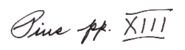
Pius, pp. XIII

Top of Page |
Pope's
Homepage |
 Email
Email
to Papal Secretary |
 |