

Marriage Between Catholics
Catholics may marry even if there is no pastor available to perform the ceremony. That is because in marriage, the bride and groom are the ministers.Marriage is simple if there are no impediments. In this statement, We
shall presume that both parties are true Roman Catholics. When no pastor
is available, the couple should try to bring relatives and friends to the
rite, and exchange the consent to be married in any form that is permanent.
| The groom would say
(for example): |
“Mary, I take thee as my lawful wife according to the rite of Holy Mother Church.” |
| The bride would say likewise: | “Joseph, I take thee as my lawful husband according to the rite of Holy Mother Church.” |
... and that is it. Of course, there must be two witnesses, and they should be Catholics, if they are available. If no Catholics are available, then two persons with normal intelligence can be witnesses. This is a Catholic rite of matrimony.
In states where it is legally required, the Catholic couple are to be married before the state, either shortly before or shortly after the Catholic rite. The couple is to make and keep records of the Catholic marriage. The marriage may not be consummated, nor may the couple live together, until the Catholic rite has been performed.
Note well, what We are talking about here, is a marriage between two Catholics. The Novus Ordo “Catholics” are Protestants. If conditions are met for a mixed marriage, a priest can dispense where the Bishop customarily dispenses. If the non-Catholic partner-to-be will not agree to study the catechism or agree to the promises, a pastor (or visiting priest) may not give a dispensation.
Laws of the Church
The laws of the Catholic Church explain the form of a Catholic marriage when a priest is not available. The method given here by Holy Mother Church must be observed. First of all, the couple must inquire if they will be in the area of the pastor sometime during the next thirty days, for any reason at all. For example, they may be visiting relatives in the pastor’s locality. They must ask the pastor if he will be in their area (during the coming month before the planned marriage) for any reason at all (for example: seeing a doctor). Once it is ascertained that they just cannot get to the priest during the next thirty days, they may use Canon 1098 #2 for their marriage. They get married before two witnesses. Here We are speaking of two Catholics getting married.Both the Catholic man and the Catholic woman are in their Catholic parish and registered with their pastor. They make their Easter Duty and receive the sacraments. As of the present (May 2000), Our parish covers the entire world, with an attachment, so to say, in Australia, where Cardinal Bateman has a parish which is the Southern Hemisphere. If the “so-called” Catholic man and Catholic woman do not belong to their Catholic parish, they are not considered Catholics by the Church. We give no marriage instructions for those people who defy the Church. Anyone who knows the Catholic Church and still remains outside their Catholic parish are non-Catholics. There is nothing the pastor can do for those until they enter the Church by joining their parish according to the laws of the Catholic Church.
With good will, all the above acts and rites can be accomplished. Those who make light of this process will never be tolerated.
Mixed Marriages
A further complication arises when one of the parties to the marriage is not a Catholic. In this case, the Catholic is to try to convert the non-Catholic to the Catholic Church. If that is impossible, then the rules for a mixed marriage apply:- The non-Catholic must take instructions in the Catholic faith to the point where he knows what the Catholic spouse must do as a Catholic.
- The non-Catholic must know also what must be done in regard to any possible children.
- Before a dispensation can be given, a “canonical reason” must be present. The Holy See (Bishop or pastor) will advise the couple on that in private.
- The promises required of the non-Catholic are:
- The non-Catholic will give the spouse full freedom to practice the Catholic faith.
- The non-Catholic agrees that the Catholic will go to Mass on Sundays when that is possible.
- The non-Catholic agrees that the Catholic will observe the laws of fast and abstinence according to the Catholic Church as seen in the Catholic Calendar.
- The Catholic will observe the rules (together with the non-Catholic) in regard the non-use of contraception in marital relations.
- As to children, each and every one of the children of that union will be baptized and raised only in the Catholic faith. This follows even if the Catholic spouse dies while the children are young.
It distresses Us when We hear that one of our young Catholics is keeping company with a non-Catholic boy or girl. The second Epistle of St. Paul to the Corinthians, 2,14-17 has these strong words about mixed marriages:
“Be ye not unequally yoked together with unbelievers; for what fellowship hath righteousness with unrighteousness? And what communion hath Light with Darkness? And what concord hath Christ with Belial? Or what part hath he that believeth with an infidel? And what agreement hath the temple of God with idols? For ye are the temple of the living God; as God hath said, “I will dwell in them, and walk in them; and I will be their God, and they shall be My people.” Wherefore, come out from among them, and be ye separate, saith the Lord, and touch not the unclean thing, and I will receive you.”In an area where a Catholic spouse is difficult to find, if a Catholic thinks that a certain non-Catholic person might be a good spouse, (before all else) try to secure that he or she becomes a practicing Catholic before any company-keeping gets started. A word to the wise is sufficient.
Casti Connubi of Pope Pius XI
Casti Connubi, an encyclical of Our predecessor of happy memory, Pope Pius XI, on December 31, 1930, leads the way to Our teaching on the elements of a Catholic marriage. Regarding mixed marriages, his encyclical states:The Church requires pastors to admonish their flock against such marriages as ruinous to the salvation of the faithful and hurtful to her interests. She grants a dispensation only with great reluctance, for the gravest reasons, and only under the following conditions:
- The Catholic party must be left free in the exercise of the Catholic religion.
- The children must be brought up Catholics.
- The Catholic party must promise to strive, by prayer, good example and other prudent means, to effect the conversion of the non-Catholic party.
Church Law is Firm
Just why does the Church demand that the Catholic party stands firm in the Catholic faith? It is because it is a dogma of the faith that: “outside the Church there is no salvation.” The Church can never give consent to anything contrary to God’s laws. If the couple determine to go their own way, independent of the Church, that is their decision before God. They will be judged justly when they die. St. Augustine said: “He who will not have the Church for his mother on earth will not have God for his Father in heaven.”Venue & Celebrations
The ideal Catholic marriage is done with reasonable celebrations before the Catholic community. Where Catholic Church buildings exist this can be very beautiful. In the final analysis, however, in order to get to heaven We must live as God directs us in the bosom of the one, holy, catholic and apostolic Church.The Catholic Church Has the Divine
We have within Us the divine in the form of the papacy. Those who do not have the divine and Catholic faith are unable to see that. We have previously taught how objects interact using the example of two stems of straw. Insert a steel wire into one straw, and leave the other stem empty. Bring those straws up to a magnet, and although the straws look the same, the straw with the steel wire in it will be drawn up to and attached to the magnet. The other straw has no attraction at all. If you have the Catholic faith you will react towards Us as the stem of straw with the steel wire in it. Only those with the “steel wire” (so to say) of the Catholic faith can have any interaction with the divine.This was written for those of good will. Remember that the angels told the shepherds that there would be “peace on earth to men of good will.” Those without good will have no promise of peace, neither in this world nor in the next.
Given in Spokane, Washington, May 15, 2000
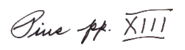
Pius, pp. XIII

Top of Page |
Pope's
Homepage |
 Email
Email |
 |