

The solution for a doubtful sacrament is the repeating of it “conditionally.”
When We look over history We find a pull in two directions, namely, that Catholic sacraments given by non-Catholics are valid or invalid, and there are times when there is big gray area between validity and invalidity. That is the problem before us today, due to the cunning of the changes before Us.
Pope St. Sylvester maintained against the urging of St. Cyprian that the sacraments of heretics at that time were valid. After the Anglican Prayer Book gave the English Church a revised form of Holy Orders, Catholics universally denied that their Holy Orders were valid. Finally, Pope Leo XIII closed down any argumentation on the problem by declaring Anglican Orders invalid.
The reason why Pope Leo XIII declared Anglican Holy Orders invalid was because the intention of the rite was defective. Once that is present no minister of the sacrament (while using that rite) can make it valid by his personal correct intention. Hence, it is good to state what is required in a valid sacrament. There must be correct matter, form and intention of the sacramental rite and of the minister of the sacrament. In dealing with the Council Vatican II sacrament of baptism we are dealing only with the faulty rite as it is found in their official book of rites.
In passing it should be noted that the validity of sacraments also hang on the condition of the minister. He may be temporarily impaired by dope or alcohol. He also may be permanently impaired by Alzheimer disease.
In this study we use Council Vatican II book of rites, entitled: THE RITES OF THE CATHOLIC CHURCH as Revised by Decree of the Second Vatican Ecumenical Council and Published by Authority of Paul VI. English translation prepared by The International Commission of English in the Liturgy, Pueblo Publishing Co., New York. The imprimatur is dated July 14, 1976. The various updated “sacraments” came into being at various dates, long before this compendium was published.
The first flag that signals trouble is the very title of the chapter which introduces what should be the sacrament of baptism. It is: THE RITE OF CHRISTIAN INITIATION (page one). There are three important effects flowing from the Catholic concept of the sacrament of baptism. They are: a- the forgiveness of original sin (and possibly actual sin) which then gives sanctifying grace, b- the giving of an indelible character on soul and c- it makes one a member of the one, holy, catholic and Apostolic Church. All these effects follow even when they are given validly by non-Catholics. Right here We shall ask the question that must be answered. Is it the intention of “the Rite of Christian Initiation” to give only the third effect of the Catholic sacrament of baptism? Our studies lead us to that conclusion. We are presuming that the authors of this Novus Ordo rite said what they meant, and they meant what they have said. That is how We want to be understood.
For those of you that will never see the Novus Ordo Ritual, called: THE RITES we shall give you some startling facts. The book is six inches by nine inches in size. The rite and treatment of THE RITE OF INITIATION runs from page one to page 284. In contrast the Catholic ritual called: RITUALE ROMANUM is four and three quarters inches by seven inches in size. While it is true that the print size is somewhat smaller there are a total of only 72 pages. The only reason We can see for the added 212 pages in the Novus Ordo “ritual” is to completely bamboozle the public.
THE RITES of the Novus Ordo starts on page 3. It goes to page 12 as an introduction, which is called Christian Initiation, and that introduction is in the title on the top of all the pages. This general introduction sets the stage, that is, the motif for the two following divisions. They are Christian Initiation of Adults (pages 13 to 182) and Baptism for Children (pages 183 to 284). That means that THE RITES rambles along for 181 pages before it is even suggested (in any title) that it is dealing with baptism. Leo XIII blamed the English of emptying Catholic words of their meaning when accidentally used in their rite of ordination, and that seems to apply here also.
As one reads through the initiation rites he is astonished at the many occasions where the minister of the rite is given an option to use the given formula as is or just continue without the formula, with an ad-lib performance. Hence, when the rite is over, unless you saw and heard it, you would have no assurance as to what actually transpired. In the Catholic Rituale Romanum there are no such ad-lib options. It is set in stone, and that is it. Since THE RITES is fluid, [some sort of norm for the performance] one finds it impossible to nail it down for certain, whether one must call it valid, doubtfully valid of just invalid?
From THE RITES on page 39, we read:
“VI ADAPTATION BY THE MINISTER
67. It is for the celebrant to use fully and intelligently
the freedom which is given to him either in the General Introduction (34)
or in the rubrics of the rite. In many places the manner of acting
or praying is intentionally left undetermined or two possibilities are
offered, so that the celebrant may accommodate the rite, according to his
prudent pastoral judgment, to the circumstances of the candidates and others
who are present. The greatest freedom is left in the introductions
and intercessions, which may always be shortened, changed, or even increased
with new intention (stress added) in order to correspond with the circumstances
or special situation of the candidates (for example, a sad or joyful event
occurring in a family) or of the others present (for example, joy or sorrow
common to the parish or town.”
There is a further novelty (aberration) on page 6, in paragraph 10, regarding a godparent, thus: “3) be a member of the Catholic Church, canonically free to carry out this office. A baptized and believing Christian from a separated church or community (stress added) may act as a godparent or Christian witness along with a Catholic godparent, at the request of the parents and in accordance with the norms for various ecumenical cases.”
We are dealing with reality. On December 14, 1998 John Paul II addressed his bishops of Australia on the occasion of their ad limina visit in Rome. While criticizing them for their carelessness in their liturgical conduct he said: “A weakness in parish liturgical celebrations in Australia [(added) could be the world] is the tendency on the part of some priests and parishes to make their own changes in liturgical texts and structures, whether by omissions, by additions or by substitutions, occasionally even in central texts such as the Eucharistic Prayer.” We do not take John Paul II seriously, for We believe he merely made the above criticism (for his own credibility) for the benefit of those who wanted to hear it.
We have an embarrassing question. The whole motif of everything in the rite up to page 183 where the rite called RITE OF BAPTISM FOR CHILDREN starts, everything is set into the concept of initiation. Will the authors say that they want to give a different “baptism” to the adults than to the children? We think not. Otherwise those baptized as adults would be different Christians than those who were baptized as infants or children. That would mean that a sheep and a goat are the same thing.
There is a troubling statement on faith that surfaces over and over. For example on page 188 in paragraph two the following statement appears: “The Church has always understood these words to mean that children should not be deprived of baptism (How about saying they must be baptized?), because they are ‘baptized in the faith of the Church.’” (emphasis added) They really have not been even “initiated” into the Church, but they have merely been initiated into the faith of the Church.
In paragraph two of the same page (188) the problem surfaces again. We quote: “To fulfill the true meaning of the sacrament, children must later be formed in the faith in which they have been baptized.” This seems to be what the Novus Ordo authors mean when they speak of “the experience of faith” as seen in THE RITES on page 50. “...they remain together to share their fraternal joy and spiritual experiences (stress added).” True faith is an act of the intellect informed with the infused divine virtue of faith by which one believes without fear of error all the truths of God’s revelation as taught by the one, holy, catholic and Apostolic Church. The act of true faith is a calculated act; not what THE RITE calls an experience.
On top of page 234 the traditional profession of faith ends, and the parents and godparents respond: I do.
The entire number 123 as is found on page 234 is as follows:
“The celebrant and the congregation give their assent to this profession
of faith:
- Celebrant:
- This is our faith. This is the faith of the Church. We are proud to profess it, in Christ Jesus our Lord.
- All:
- Amen.
There you see the insecurity of the rite. The celebrant and people present, may profess a faith [with a separated brother] that they (for example) are saved “by accepting Christ as their personal Savior,” which of course is a false belief.
Number 124 follows:
“If there are several ministers because of the large number to be baptized,
each of them questions the parents and godparents, using the name of the
individual child.
- Celebrant:
- Is it your will that N. should be baptized in the faith of the Church, which we have all professed with you?
- Parents and godparents:
- It is.
- He baptizes the child, saying:
- N. I baptize you in the name of the Father,
- He immerses the child or pours water upon it.
- and of the Son,
- He immerses the child or pours water upon it a second time.
- and of the Holy Spirit.
- He immerses the child or pours water upon it a third time.”
Immersion is suggested as an optional procedure. What if the celebrant just dunks the body into the water up to the chin? You would have a doubtfully valid (Catholic) baptism.
It is the duty of the Catholic Church to direct in minute detail how to baptize so that there is no question as to the validity of the sacrament. You see that there are many misconceptions in the Novus Ordo rite which can cause it to be invalid or doubtfully valid.
On page 123 of THE RITES it directs three pourings thus: “he pours the water a first time.” which is repeated three times. It does not say where he is to pour the water. The Catholic Rituale Romanum directs that he pours the water on the head of the one baptized.
We are now at the point where the most damning part of the Novus Ordo rite must be exposed. The celebrant is directed to ask the parents their intention that the child is to be baptized. We repeat it here: “Is it your will that N. should be baptized in the faith of the Church, which we have all professed with you?”
We presume that Our readers know that the interrogation by the celebrant in a true Catholic baptism is: “N. wilt thou be baptized?” Not one word follows the word “baptized.” Any single word that follows the word “baptized” has the possibility of modifying that verb. It has the possibility of destroying the correct theological meaning of “baptism.” And how did Leo XIII deal with Anglican Orders?
An exact study of the words following the word “baptized” in the Novus Ordo rite must be made. They certainly modify the meaning of “baptized.” Just what does “...in the faith [(added) Catholic? Protestant? or both?] of the Church, which we have all professed with you?” really imply?
When the Catholic Church asks, “Wilt thou be baptized?” it is giving the sacrament in its true meaning. Everything that is taught by the Church about baptism rests firmly in that single word, “baptized.” Hence, there is not a single word added that might derogate from that full theological meaning.
Lest some of you may think that modifying a word does not destroy its original meaning, let us give an example using a diamond. It is known that diamonds are hardened coal, and they are considered very valuable. The jeweler asks you if you want to buy a diamond as follows: “Do you want to buy a diamond?” If you agree to buy a diamond the jeweler must give you what is generally known to be a diamond, namely, hardened coal. That is how we understand conversation.
Let us for example change the question of the jeweler to the following: “Do you want to buy a diamond made of plastic? The words “made of plastic” modify the word diamond to the point that there is no hardened coal at all. In fact it is a synthetic diamond.
When the minister of the Novus Ordo rite of baptism (or initiation) adds “in the faith of the Church, which we have professed with you” that means that he is being baptized into only a possible part [faith] of the Church. That is unacceptable to the Catholic Church, and the Catholic Church cannot accept it as a valid sacrament of baptism.
The theological repercussions of this decision are tremendous. It not only means that a person with a Novus Ordo baptism coming into the Church, as a convert, must be rebaptized conditionally, but he must also have other sacrament(s) with an indelible character that rest on the Novus Ordo baptism, revalidated conditionally. Not one sacrament can be received validly without a valid sacrament of baptism. Obviously, all ordinations resting on a doubtful sacrament of baptism are doubtful, and they will not be used unless they are done over conditionally. The same holds for Confirmation.
Looking into history, before bogus Council Vatican II, Holy Orders in the Russian Orthodox and Greek Orthodox false Churches were considered valid. At the same time the Holy Orders in the Anglican Church were judged invalid.
For the Catholic Church to accept generically the baptisms of Protestants several things come to mind. First of all, do the sects have set rites for their baptisms which are universally accepted and taught in their seminaries? If each minister determines his own procedure then each baptism must be judged on its own merits. Unfortunately, this is all too true these days.
This document does not contain any new theology on the sacramental order in the Catholic Church. It is given so that the Catholic Church does not fade out from the face of the earth with no valid sacraments. We know from faith that such a thing will never be permitted by Christ, the head of His Church. The Church will ever remain with the truth.
Also it should be noted that this document does not deal with, that is, it does not give a new judgment on the statement of the Holy Office given in Denzinger 2304, on December 28, 1949. For those working on matrimonial cases its response made it clear that the intention of those baptizing, that is, the ministers in the Disciples of Christ, the Presbyterians, Congregationalists, Baptists, Methodists was judged at that time to be correct. In order to find invalidity with their baptisms one would have to find it an area different than the intention of the minister. A statement as to intention in a sacrament being correct still leaves all the other points on which a sacrament stands open to question.
With sadness We must point out to a world wide deterioration. Since no sacrament is received validly unless there is first a valid sacrament of baptism of water, all those who have been ordained priests and consecrated bishops who had the Novus Ordo baptism are now judged by Us as doubtfully valid the only solution possible is that their sacraments be done over conditionally. Intrinsic to the ordinations and consecrations of the Bishop Thuc line and the Society of St. Pius V line there is question of validity. At the same time, in proportion as the Society of St. Pius X ordains and consecrates those with the Novus Ordo baptisms it will be as an ice berg all melted in the sea of paganism and heathenism.
Checklist
The checklist for establishing if a sacrament is valid goes as follows:- Was the minister whole in mind (not under dope, alcohol or Alzheimer)?
- Did he really want to confect the rite?
- Did he use water, and did he pour it on the skin of the head (on the hair alone does not count) so that it ran over the skin?
- Did he say all the words of the valid form while pouring the water?
- Did the total rite express the valid sacrament of baptism?
Given March 6, 1999
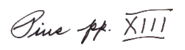
Pius, pp. XIII

Top of Page |
Pope's
Homepage |
 Email
Email |
 |