

Papal Office
The Ignored Commandment of God
Thou Shalt Live and Die in God's One Holy Catholic & Apostolic Church
Since
the French Revolution nearly the whole world
lives by what is called liberalism. In a few words, liberalism means that there
are no firm truths by which men are ruled by God and/or legitimate superiors
who have authority from God. The result
is that if one can get away with it, each man can do just as he pleases. He can determine whether he will or will not
recognize the Creator. In other words
it makes it that an atheist appears just as honorable as one who practices some
form or religion. Also, those in false
religions become just as accepted as those who practice the religion revealed
by God to man, as can be seen in the revelations of the Old and New Testaments
and interpreted by God’s holy Church.
According to the teaching of
liberalism, one is a good and honest person in any religion or no religion at
all. They see no evil consequences
following from their practices of false religions. In reality, only those are just before God who are in God’s
religion. Liberalism makes the absurd
claim that one can get to heaven outside God’s one and only religion.
We shall quote Our predecessors on this
very important teaching. Our source for
three quotations is THE SOURCES OF CATHOLIC DOGMA by Denzinger, published by
Marian House, Powers Lake, N.D. 58773 Herder Book Co.
The first quotation is from Pope Pius
IX, page 416, no. 1647: “For, it must
be held by faith that outside the Apostolic Roman Church no one can be saved;
that this is the only ark of salvation; that he who shall not have entered
therein will perish in the flood; but on the other hand it is necessary to hold
for certain that they who labor in ignorance of the true religion, if this
ignorance is invincible, are not stained by any guilt in this matter in the
eyes of God. Now, in truth, who would
arrogate so much to himself as to mark the limits of such an ignorance, because
of the nature and variety of peoples, regions, innate disposition, and of so
many other things? For, in truth, when
released from these corporeal chains ‘we shall see God as He is’ [I John 3:2]
we shall understand perfectly by how close and beautiful a bond divine mercy
and justice are united; but, as long as we are on earth, weighed down by this
mortal mass which blunts the soul, let us hold most firmly that, in accordance
with Catholic teaching, there is ‘one God, one faith, one baptism’ [Eph. 4:5];
it is unlawful to proceed further in inquiry.” (end quote). As one can see from the last admonition by
Our predecessor the matter of “invincible ignorance” is not to be over-played
and thus use it to deny or weaken the whole definition. Our conduct here will show Our caution
also. God knows all things, vincible
and invincible ignorance as it applies beyond human knowledge, and He alone
will judge each person in all justice. In the practical order We shall make the
following observation. The persons with
invincible ignorance will not know their state as it is before God. They will learn about it at their judgment
at the moment of death.
Let us place the fact (for an argument)
that invincible ignorance is present in a person. That merely makes one not responsible for his violation(s) in that
state. It in no way gives him either
forgiveness when necessary or sanctifying grace. If such a person is without sanctifying grace he can get it by an
act of perfect love (or perfect contrition).
If one in mortal (or at the dawn of reason – original sin) he can. with
the help of God’s actual grace, before, during and after the act, acquire
sanctifying grace. Once he acquires
sanctifying grace it remains in the soul until death if no mortal sin is
committed. We shall not go into a long explanation of the act of perfect love
(or perfect contrition) here, but We shall point out that the motive for
that love and/or sorrow must be expressed in four words; they are because “Thou
art INFINITELY GOOD IN THYSELF.”
The problem as We see it, in nearly all the forms of perfect love and
contrition, they corrupt the first and fourth words as follows. Infinitely becomes all, and
that is not enough. It does not equal the concept of “infinitely.” There is no problem with the word
“good.” However, IN THYSELF is generally not expressed at all or that God is
just generally GOOD – as the creator, a benefactor and the like. It must say “in thyself,” independently of
all the other concepts, of how God is good to us.
Our second dogmatic declaration of the
Church comes from Denzinger as above, quoting, number 714 on page 230. This
dogmatic statement was declared by the Council of Florence 1438– 1443. We quote: “It (the Church) firmly believes,
professes, and proclaims that those not living within the Catholic Church, not
only pagans, but also Jews and heretics and schismatics cannot become
participants of eternal life, but will depart ‘into everlasting fire which was
prepared for the devil and his angels’ [Matt. 25:41], unless before the end of
life the same have been added to the flock; and that the unity of the
ecclesiastical body is so strong that only to those remaining in it are the
sacraments of the Church of benefit for
salvation, and do fasting, almsgiving, and other functions of piety and
exercises of Christian service produce eternal reward, and that no one,
whatever almsgiving he has practiced, even if he has shed blood for the name of
Christ, can be saved, unless he has remained in the bosom and unity of the
Catholic Church.” (end quote).
This closes the door of heaven to all
men, no matter how good a life they lived, if they deliberately neglected to
obey God’s command to live and die in His one, holy, catholic and apostolic
Church.
We shall quote another Church document
on this necessity of being in God’s Church in order to be saved. We quote from Pope Boniface VIII, from his
Bull called UNAM SANCTAM, dated
November 18, 1302.
In number 469 it is stated: “And we are
taught by evangelical words that in this power of his are two swords, namely
spiritual and temporal…. Therefore,
each is in the power of the Church, that is, a spiritual and a material
sword. But the latter, indeed, must be
exercised for the Church, and the former by the Church. The former (by the
hand) of the priest, the later by the hand of kings and soldiers, but at the
will and sufferance of the priest. For
it is necessary that a sword be under a sword and that temporal authority is
subject to spiritual power…. It is
necessary that we confess the more clearly that spiritual power precedes any
earthly power in dignity and nobility, as spiritual matters themselves excel
the temporal. …For, as truth testifies,
spiritual power has to establish earthly power, and to judge if it was not
good…. Therefore, if earthly power
deviates, it will be judged by spiritual power; but if a lesser spiritual deviates, by
its superior; but if the supreme (spiritual power deviates), it can be judged
by God alone, not by man, as the Apostle testifies; ‘The spiritual man judges
all things, but he himself is judged by no one” [I Cor. 23:15]. But this authority, although it is given to
men and is exercised by man, is not human, but rather divine, and has been
given by Divine Word to Peter himself and to his successors in him, who the
Lord acknowledged an established rock, when he said to Peter himself:
‘Whatsoever you shall bind’ etc. [Matt. 16:19]. Therefore, ‘whosoever resists this power so ordained by God
resists the order of God’ [cf. Rom. 13:2]….. Furthermore, we declare, say,
define, and proclaim to every human creature that they by necessity for
salvation are entirely subject to the Roman Pontiff.” (End quote).
The above paragraph renders a wonderful
service to the faith for one and all.
It tells you that the Pope is, by God’s ordinances the highest authority
in the world both in the temporal order and in the spiritual order. He does not
rule in the temporal order, but he guides the temporal order from error and
damnation. For example, We tell all the
governments in the world that defending abortions is mortally sinful. Civil governments can never make it lawful
to have an abortion. By sustaining what
it calls a right to have abortions, it sustains the violation of the Fifth
Commandment of God, which says: Thou shalt not kill. Hence, it is no wonder when the government agencies make it
illegal to post the Ten Commandments of God on government property as local
cases may be. More and more examples
surface from time to time, and We must always speak the truth, for We hold the
place of Christ Who expresses His importance for eternal salvation as follows:
(John 14, 6) “I am the way, and the truth and the life. No man cometh to the Father (or to
eternal salvation) but by me.”
In order to continue the teaching of
this article We shall come back to the final words from Pope Boniface
VIII. “Furthermore, we declare, say,
define, and proclaim to every human creature that they by necessity for
salvation are entirely subject to the Roman Pontiff.”
Liberalism says just
the opposite of the defined doctrine of Pope Boniface VIII. Liberalism says, for everyone’s convenience
and fatal error, that every one can be saved in any religion or even no
religion at all.
It is a matter of history that for the
most part of his life St. Peter ruled the Church from Rome, and he died
there. Over the centuries his
successors ruled the Church from Rome while living there. However, it is also a matter of history that
there were times when the Pope, the Vicar of Christ, lived outside of Rome, but
he was known always as the Roman Pontiff.
Make your own studies of this matter, available from the Catholic
Encyclopedia, if you want to know that history.
There is a problem for some today,
namely that We do not live in Rome.
Hence, how can We be the successor of St. Peter? We are the Pope of Rome in exile. The impostures living in Rome since the
death of Pope XII are not the successors of St. Peter, nor are they the Vicars
of Christ. Those who follow them must
deny their catholic and apostolic faith.
Why? It is because many teachings
give out by those men, John XXIII, Paul VI, John Paul I, John Paul II and
now Benedict XVI are heretical. The
documents of bogus Council Vatican II are full of errors, and the new liturgy,
their “Mass” is not only heretical but it is also invalid. Even if it were valid it would be fruitless,
for God does not give graces through heretical Churches. Never forget the dogma: outside the Church
there is no salvation, there is no giving of forgiveness of sin or giving of
graces. Just by the way: children
born of people in heretical churches, if they receive a valid baptism they get
the baptismal character and graces, for they become Catholics by the baptism of
infants, and they lose those graces when they gain the use of reason and
embrace the false religion of their parents or non-catholic associates.
Since there are only two places on
earth today where the Mass and sacraments are regularly given, there are many
Catholic who never once get a chance to meet the priest. It is very easy for them to grow lukewarm
and abandon the faith, and then lose their souls. This problem is especially dangerous for the children of Catholic
parents, for they grow up only as they are lead by their parents. They must observe, of course, the laws of
the Church, which meet them day after day.
For example, they must keep the Lord’s Day (Sunday) holy by prayer and
study of their holy faith. They should
dress for Sunday so that the whole day is kept sacred, not just a free day for
fun and sports. They must observe the
fast and abstinence days, and of course, Friday is a meatless day. Lent brings fast days for those of age for
that practice.
They are obliged to support the Church according to their means. For many it is impossible to go to confession once a year and make their Easter Duty, that is, receive Holy Communion between Ash Wednesday and Trinity Sunday. In order to make sure that every Catholic makes his Easter Duty We have made the regulation, call it a Church Law, where those who cannot get to Communion during the Easter season must write a letter to their Pastor or to the Pope himself. That letter must be more than just a friendly chat. They must tell the priest that they are practicing the Catholic faith all the time. They keep Sundays and Holy Days of Obligation holy. They observe the laws of fast and abstinence. They study the faith from truly Catholic literature. If this is neglected and/or ignored there is a serious violation of a Church law. Hence, the person falls into mortal sin, and he remains in that sin until he performs his Easter Duty. It is no different than it has always been. Those who neglected their Easter Duty of receiving Communion when they could normally attend Mass puts them in mortal sin. One gets out of that sin by repenting for his sin and also makes his Easter Duty.
It seems that the very concept of being
a Catholic is getting confused. Some
people seem to think that they can be Catholic by determining that they are
Catholics by themselves, that is, without any conversion or reception into the
Church by a priest subject to the Pope.
Also, some children are growing up their with Catholic parent(s), and
they never make any personal contact with the priest or Pope. Once they reach the age of reason they are
obliged to the Easter Duty. If they
ignore that, and the years pass by, gradually they lose all contact with God’s
one, holy, catholic and apostolic Church.
They become as “heathens and publicans.”
Some persons who are not Catholic may
read this letter and wonder what they must do in order to become
Catholics. First of all, they must
become catechumens. They belong to
those who want to become Catholics in order to be saved. In some way they must be instructed and
tested on their knowledge (and acceptance) of the truths of the faith. Here is a bit of history.
During the time that We studied
theology [during the 1940’s] (the last four years in the seminary) there was a
program where persons could learn their catechism via a mailing correspondence
course. The catechumen purchased a
catechism and received several questionnaire slips. They filled out the questionnaire slips as they progressed in the
course. A seminarian corrected the test(s)
and returned them so the catechumen could see if they were getting things correct. Once they graduated to the satisfaction of
the seminarian in charge of the tests, the catechumen was told to go to the
pastor in there area for final approval and formal reception in the Church. The Roman Ritual has formulas for reception
into the Church, which every priest must follow. We will not go into the various forms of reception into the
Church except to mention that there is a difference when the person has or does
not have a valid baptism of water already.
At the time that the catechumen becomes
a Catholic the pastor records the person as a member of his parish. Once that is done the person belongs to that
parish not only because he is recorded there but also because he lives in the
area of the parish. A Catholic cannot
choose his parish, for Church law requires that he be a parishioner in the area
(parish) where he lives. When one changes his place of residency he then
becomes a member of the parish where he then lives, as before.
In ideal circumstances a Catholic
country supports the Church with funds that it has from general taxes. However, We know of no such a Catholic
country today. Hence the support of the Church falls directly on the shoulders
of each individual Catholic. The Fifth
Commandment of the Church presumes such a situation, for it states: that
Catholics are bound to support their pastor, and of course, all the operations
of the parish. That includes the priest
or priests if there are more serving the parish, plus the upkeep of the priest
residence, the upkeep of the Church, the upkeep of the school and all such
parish operations. Generally, the
support of the pastor is done by giving him a salary. Ideally, Catholics try to have parish facilities for the
education of their children. Catholic
children should be educated in Catholic schools, and generally Religious
Sisters and Brother staff them. It is
also desirous that Catholics band together to set up Catholic High Schools,
Catholic Colleges and Universities.
The more that the Church can be united
in daily lives of the Catholics the better.
Catholic orphanages care for the physical and spiritual needs of
orphaned children. Catholic hospitals
with at least part of the staff made up of Sisters and Brothers, take care of
the sick and dying. They do all they
can to have the patients receive the Sacraments, even daily Communion. They administer to the dying with all
solicitude so that the dying have all the help that is possible in order to die
in the state of sanctifying grace and go to heaven.
With a great apostasy upon us now each
individual must fend for himself in life and in death. Now We plus one priest must serve the
sacramental needs of the whole world as far as is possible.
Some prayer books have prayers for
vocations. The faithful must pray that
the Lord of the Harvest sends laborers in the service of the Church. Devout families include a prayer in their
regular exercises of piety asking God to call one or more of their children to
serve in the Church as a priest, Brother or Sister. Our parents gave four sons to the Church to serve in the Capuchin
priesthood with three of them working in foreign lands as missionaries. Our mother’s parents gave a son, to be a
Jesuit Brother, and two daughters to become Dominican Sisters, to the
Church. It is true that great
sacrifices are required of Catholics. However, we know for certain that God
rewards in all justice. The more
sacrifices and generosity in the service of God the higher will be the reward
in heaven.
Our Lord promised that His
Church would continue to the end of time.
If the people on earth continue to ignore the Church, and if the
Catholics die off in their laxness, then there will be the end of the
world. There will be no world without
God’s Church, no matter how hard the devil works and how the people on earth
sleep on the job.
Each one of you consider this.
Having only one unforgiven mortal sin at death will certainly put one in hell,
forever. Only if one has obeyed all of
God serious commands (and thereby having sanctifying grace) will he go to
heaven. Do not chance disobeying God’s command to be in His Church, for such an
act would be fatal for all eternity.
PRACTICAL STEPS
Those with concerns about their eternal salvation should contact Us or Father Robert Cardinal Lyons (his email number at) sacerdos@verizon.net. No one can put himself into God’s Church, but he must be received into the Church by a Catholic pastor who functions in God’s one and only Church, under the direction of the Pope and officers down the line of authority.
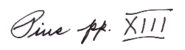
Pius, pp. XIII
Aug 1st, 2005

Top of Pageto Papal Secretary


©truecatholic.us
