

Basics of the Faith
If you were in attendance where a man (or woman) was only an hour away from being executed, and if he was calling for help to get out of sin and into heaven. What would you do to help him? Here is what the Catholic faith tells you to do for him.
The first step is to instruct him on the four things a person must know and believe in order to receive forgiveness of his sins and receive sanctifying grace, without which nobody can enter heaven – whether he knows it or not.
The first thing one must know and believe with divine and Catholic faith is that the world (everything outside of God himself) was created (made from nothing) by Him whom we call God.
The second thing one must know and believe is that God keeps the world in existence and rules it. Of course, basic to all this, one must believe in the immortality of the human soul, and that soul and body are made to enjoy heaven forever.
Since the coming of Christ two more basic truths must be known and believed in order to get heaven. Those truths are, first of all, the knowledge of the Blessed Trinity, three person (Father, Son and Holy Ghost) in the one God.
The second truth that came with Christ is the truth of Incarnation, where the Second Person of the Blessed Trinity became man, was born of the Blessed Virgin Mary, founded His Church, suffered and died to redeem all men.
If the man to be executed testifies that he understands your instructions, believes them and finally was sorry for his sins, he is then ready for the baptism of water, which if impossible, he can make the act of perfect contrition (under your instructions) which gives him the baptism of desire. With that, if properly done, he can appear before Christ His judge and receive the reward of everlasting supernatural life forever in heaven.
A situation like this is highly unlikely, but every Catholic should know this with a clear knowledge and lively faith.
Our main concern with this letter is to state briefly the Ten Commandments of God and explain the Commandments of the Church which in this day and age require illumination, lest they be lost by those who are lukewarm in their daily practice of the faith.
Just for the record, We shall state the Ten Commandments of God, and leave them before you without an explanation. An explanation will have to wait for another occasion.
The TEN COMMANDMENTS OF GOD are:
- I am the Lord Thy God: thou shalt not have strange gods before Me.
- Thou shalt not take the name of the Lord thy God in vain.
- Remember that thou keep holy the Sabbath day.
- Honor thy father and thy mother.
- Thou shalt not kill.
- Thou shalt not commit adultery.
- Thou shalt not steal.
- Thou shalt not bear false witness against thy neighbor.
- Thou shalt not covet thy neighbor’s wife.
- Thou shalt not covet thy neighbor’s goods.
The SIX COMMANDMENTS OF THE CHURCH are:
- To attend Mass On Sundays and Holy Days of obligation.
- To fast and abstain on days appointed.
- To go to confession at least once a year.
- To receive Holy Communion at least once during the Easter season, or when that is impossible to write a letter, professing their faith and love for the Holy Eucharist, to the pastor.
- To contribute to the support of the Church.
- Not to marry within certain degrees of kindred, nor to solemnize marriage at forbidden times.
Here We must address a problem which We did not make, but it is one with which We must cope. Set in front of yourself a dozen pre-Vatican II catechisms, and you will find some using the terminology Commandments of the Church and others using Precepts of the Church. Both mean the same thing, so using one or the other will not change the topic. We take opted to use the term Commandments of the Church.
In Our last newsletter [#45] We modified the Fourth Commandment of the Church by an extension. When going to Communion during the Easter season is impossible then Catholics must write a letter, professing their faith and love for Our Lord in the Holy Eucharist, to their “pastor” as circumstances may have it.
Before We go into an explanation of the Commandments of the Church, We shall comment on the method of knowing the exact days when the various obligations oblige. You must know in your various countries your Holy Days of Obligation, the days of fast and abstinence, and the like. The Catholic calendar notes the Holy Days of obligation, the fast and abstinence days and so forth. When the faithful go to Sunday Mass every week they are told by the priest what obligations appear in the week that follows. We grew up thus, plus having a Catholic calendar from the Catholic undertaker in the area. During these difficult times We tell the faithful where they can purchase a calendar which is generally correct and can be followed.
The First Commandment of the Church commands the faithful, from the age of reason, to attend Mass on all Sundays and Holy Days of obligation. Besides going to Mass the faithful must abstain from servile work. If one goes to Mass and arrives after the offertory he has missed Mass. If he leaves before the Communion he has missed Mass. He also must pay attention to the sermon, as part of the obligation. There is a truism which goes as follows. What you do not use you lose. Add to that, learning that you do not repeat you also lose. That is the formula for becoming lukewarm and finally a fallen-away Catholic.
In these days of trial each Catholic must feel in conscience bound (those who can read) to read their Missal using the Mass for all the Sundays and Holy Days of obligation. If he has no such a Missal urge him to purchase one. In the USA there are several pre-Vatican II Daily Missals on the market, ready for purchase. Besides the Missal there are other readings that are available in the English language. For example, the very excellent, THE CHURCH YEAR, of 1880 by Leonard Goffine is available from Angelus Press, 2915 Forest Avenue, Kansas City, MO 64109 USA, 1(800)966-7337. There are many very excellent books of Catholic learning and Catholic devotion on the market. You can come to Us or Our priest for advice in this all important matter.
The entire Sundays and/or Holy Days of obligation require all Catholics to abstain from servile work. That is the kind of work that people do in order to make a living. That may be farming, day labor, store clerk, accountant and the like. When you are in a bind to know if what you want to do is servile work ask the priest for his advice and direction.
Making the Lord’s Day holy as God commands, would also include the need to dress for the occasion. One should not dress on Sundays with work clothing except when that is necessary, e.g. when a farmer milks his cows and cleans the barn.
Sundays may have some games and mundane recreation. However, to occupy nearly the entire day in such Godless activities can lead to lukewarmness and the loss of one’s faith. A very fine practice for Sundays is to visit the sick, generally a sick relative or friend. Bring them some joy and a treat to eat and/or drink. Let your love for God bubble over in your love for your neighbor.
Today a small breviary is hard to find. In former times the Catholics used to return to the Church on Sunday afternoons to recite Vespers. The Psalms that are used in prayer have a special flavor. By way of history We tell you that Our mother who raised nine of us children – four of them priests – daily prayed a number of Psalms. God had her to live to the grand old age of one hundred and four. May she rest in peace.
The Second Commandment of the Church requires Catholics to fast and abstain on days appointed. Here again a Catholic calendar has a part to play. Those days, as well as Holy Days, are not the same in all countries of the world. Your Catholic calendar tells you the days which are fast and abstinence days. Generally, all week days of Lent are fast days. This binds those between the ages of twenty-one until their sixtieth year of age, once they reach their fifty-ninth birthday they go into their sixtieth year of life.
Fasting means that one may eat only one full meal a day. That meal is called the main meal of the day. The other two other meals, in the morning and at noon or night, when one may eat the equivalent of their full meal divided in half: half at each of those two meals. Those who must fast may eat meat but only once, and at the main meal of the day. The Ember Days, marking the four seasons of the year, are partial abstinence days. That means that on those days all are bound to abstain from meat except at one meal. Those who must fast may eat meat only at their main meal, whether they choose noon or night for that meal.
Abstinence binds all Catholics from the age of seven until death. That means that they may not eat any meat or drink meat juices. On partial days of abstinence (Wednesdays and Saturdays of Ember Days) they may eat meat at one meal – be that, breakfast, dinner or supper. Those who must fast are covered in the above paragraph.
Pig fat, known as lard, may be eaten on days of fast and abstinence. Such fat is generally used in preparing fried potatoes and fried eggs and the like.
What must be done in difficult circumstances? A woman who is pregnant is not bound to the law of fast. Persons who have very difficult (heavy) manual labor are not bound to the fast while that labor is imposed. Those who are seriously ill are not bound to the fast. Note that the sickness must be notable. A slight cold would not excuse one from the fast.
Once again, when people went to Church every Sunday the days of fast and abstinence were announced to them before the Sunday sermon was given. In these days, the reasonable way to keep informed of the days of fast and abstinence is with a Catholic calendar. We have such little help that We do not have a Catholic calendar. Every year We tell the faithful living in the USA what calendar to purchase and follow. Once again, those days differ in different countries. All the faithful in the world may use the calendar that We recommend. However, if they can acquire the Catholic calendar recognized by Us for their country they are to follow that one.
The Third Commandment of The Church requires that one goes to confession at least once a year. That may be either during the Easter season or outside of the Easter season. It goes without saying, that confession like the reception of Holy Communion must be received from a priest subject to the Pope and in good standing with him. Freelance priests today, as the saying goes, are a dime a dozen. Have nothing to do with them except, use any validly ordained priest for confession when you are in the serious danger of death. Outside of such a need no Catholic may approach a priest for the sacrament of penance (and that alone) from the priest who is not subject to the Pope.
In Our last newsletter (#45) We covered the Fourth Commandment of the Church. With no date of termination We extended this Commandment. The Church commands the faithful to receive Holy Communion during the Easter season – from Ash Wednesday to Trinity Sunday. If one can do so and neglects to receive Holy Communion [fruitfully] during that season, he violates the Commandment, and falls into mortal sin. Confession and the reception of Holy Communion will get him out of that sin. A person who is living in mortal sin, e.g. one living in an invalid marriage cannot receive Holy Communion fruitfully until he gets out of that sinful way of life and is purified with the sacrament of penance.
What We did to the Fourth Commandment of the Church is this. When Holy Communion cannot be received because one cannot go to the priest, or the priest does not get to the Catholic, then the Catholic with the use of reason, until death, must write a letter in which he/she testifies that he/she believes as a Catholic and states his/her loyalty and union with the reigning Pope. Right now there are a number of Catholics who, over the years, make no contact with the priest or the Pope.
The Fifth Commandment of The Church requires that all Catholics do their duty to supporting the Church and Her various activities. Just think of the days of yore. There were Catholic hospitals. In fact, hospitals with their works of charity are a Catholic Church invention. When the Novus Ordo took over, the Sisters and the Novus Ordo Church in general gave up their hospitals to money hungry non-Catholic administrators. Then down came the Crucifix in the main office, and later down came the crucifixes in the rooms.
Besides running hospitals the Sisters and Brothers had Catholic Schools, Catholic orphanages, and general Catholic Charities. Catholics contributed towards all of these operations according to their abilities. Some brought potatoes, and some brought money. The boys with a priestly vocation were trained by the Church in seminaries, and they were fed and housed by the Catholics in general. Generally, the priest is not suppose to get a secular job to pay his rent and food. In Catholic Rites where some of the priests are married and the faithful are few and far between the priest still may have to be employed in some kind of job to make ends meet. It is not an ideal situation, but we must live in the circumstances as divine providence permits.
The works of charity go right down to the individuals in the individual parishes. We have in mind the active St. Vincent de Paul Society. We have seen a small group of their men gather every week at room in the parish to determine what they were going to do about the poor who applied at the Church office for help. They sent out a member to visit the poor and destitute families, and they brought back to the next meeting their observations. All would agree on a method of helping those poor: be it food, clothing, rent money and the like.
Let Us place the works of charity before you this way. The majority of people settle for contributing money according to their means. Others give personal service at the parish site. Still others give themselves completely in the service of the Church, the Mystical Body of Christ. Let Us give you just a small prospective of one such person, and he is Us. After grade school We entered the Minor Seminary (like a High School course) which was a hundred and fifty miles from Our home. After four years We entered the Capuchin Novitiate, lasting one year. After entering the Novitiate We never once received permission to visit Our home or any home. We did four years of Philosophy and four years of Theology. That was crowned by Our receiving the priesthood. A year after We graduated from the seminary We received the assignment to be a foreign missionary in the Ryukyu Island (now a part of Japan). We served there for twenty one years. Besides making many converts We conducted the construction of nearly fifty mission buildings – Churches, priest houses, a medical dispensary, a grade school united with a High School, and among many other services one entire Sisters’ convent-complex. The last and crowning construction was Our building the first Capuchin friary in Japan. We left Our work in Japan before the paint was dry in that place. Amid all that We held the office of pastor in several places, and in one We averaged one convert every week the year around. The records are there to be exposed on judgment day.
After Our tour in Japan We served the rest of Our foreign mission time, twenty eight years in all, in Australia, a missionary assignment also. Just try to imagine what a different place Japan would be today if We had not given to those people Our dedicated service of twenty one years and three months! It is sad but true that every single one of Our converts now live in the darkness of the Novus Ordo. Please God, may that dark night be once more lightened with the light of the true faith under the direction of Us, the true Pope.
To move on to the conversion of many people, the Catholics of today must live the Catholic faith to the full. Some few are still generous, but the general run of Catholics today should consider the quotation from the Apocalypse 3, 16. “But because thou art lukewarm and neither cold nor hot, I will begin to vomit thee out of my mouth.”
God left the whole world except the family of Noe, eight members in all, to be lost in the flood, and from those eight persons the whole world today has its origin. Must history repeat itself and like the time of Noe: this time, in the spiritual order, where nearly the whole human race is consumed in the flood of sinful lives leading only to hell?
The Sixth Commandment of the Church requires that Catholics observe the laws of God and the Church in regard to marriage. The first one to consider is, avoid marriage with a non-Catholic. With so few Catholics today the problem resolves down to this. Seek a Catholic partner or convert a non-Catholic person for marriage. With tears in Our eyes generally We see Our Catholic boys marrying non-Catholic girls, and the Catholic girls marrying non-Catholic boys. Live your faith to the full, and God will provide you with a suitable partner in marriage if married life is His vocation for you.
Avoid marriage with those too close in your bloodline, as will be explained to you if you have a question, and by all means before any courtship.
Do not marry during the penitential season of Lent unless you are willing to settle for a marriage without a family and friends celebration.
A caution to all brides: wear a totally modest dress. You may even have to settle for a garment not originally designed for a wedding garment. When all Catholics always and everywhere dress modestly this caution will no longer be necessary.
Blessing of St. Francis
May the Lord bless thee and keep thee:
May He show His face to thee and have mercy upon thee:
May He turn His countenance to thee, and give thee peace.
May the Lord + bless thee.
Try to acquire the habit of spontaneously praying: “Jesus, Mary I love Thee. Save souls.”
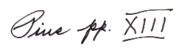
Pius, pp. XIII
October 26, 2004

Top of Page |
Pope's
Homepage |
 Email
Email
to Papal Secretary |
 |