

God’s Order Or Chaos
An example of what is meant in this title can be seen by considering the great flood. God’s order was in the Ark of Noe, and chaos was outside of the Ark in a world where God destroyed by drowning every human being. Thereafter the human race follows from the lives that were preserved in the Ark during the flood.
When God created the world He gave the things of this world to be used by Adam and his posterity to the end of time. Please note the words, “to be used” by man. The soil, plants and animals were to be used in such a way that all men had what was necessary for normal life. In order for that to be accomplished man has to use his judgment by the application of his divinely assisted virtues of justice and charity.
The Roman Empire gives us an example of what should not be done in society. Strong men organized a mighty military force and conquered the world. Scholars developed a spectacular governmental system, still seen in remnants of Roman law. Pleasure loving men developed methods of pleasure. To satisfy gluttony they had vomiteries in their homes so that after being filled they could regurgitate their food in preparation to eat more and more. In Rome their monument of pleasure, that is, the Coliseum reminds posterity how they enjoyed games, animal fights to the death, gladiator fights to the death and so forth. They became so sadistic that the letting of blood was their final way to achieve pleasure. They ruled the world, but their decadence weakened them to the condition where savage hoards took them over.
There is truism which goes as follows: “They who cannot learn from the past are doomed to repeat the mistakes of the past.” The English use to say: “The sun never sets on the British Empire.” Today one might say: “The sun never set on the USA military.”
The purpose of this document is to bring forth the things that are necessary for a Godly society. All order comes under the will of God. Hence, where there is disorder God is offended. Those of good will must work for an order in this world where all men live in honor with their needs supplied in a just and charitable manner.
This is not as simple as some may think. In order to accomplish right order men must be in God’s one, holy, catholic and apostolic Church, for in it alone (in the souls of individual Catholics) there is sanctifying grace. Sanctifying grace gives supernatural life to the soul. Added to sanctifying grace are the theological virtues of faith, hope and charity plus the moral virtues of prudence, justice, temperance and fortitude. All these are supernatural. Those without faith cannot comprehend this problem. Hence, they try to set up good order in society merely by the application of natural prudence and natural (do good) charity. One need not be a rocket scientist to conclude that devil worshipping Masons who generally rule the civil world today are headed for total shipwreck. Thus one sees that the truism “Those who cannot learn from the past (from the failure of Godless men in power) are doomed to repeat their mistakes.”
The Catholic Church is not silent in this regard. We wave before you two very wonderful documents. The first is Rerum Novarum by Pope Leo XIII. And the second one is Quadragesima Anno by Pope Pius XI. Our predecessors called for a social order where workers were assured of a just wage, that is, a wage sufficient for a man to take care of himself and his family. That is usually referred to as a living wage.
Since things in society constantly change and develop, scholars and governments must cooperate in instructing the general public. When Our parents were married their transportation consisted of trains and horse and buggy. By the time We came into this world Our father was driving a Model T Ford. Obviously the method of setting a fair price for a horse and buggy was much simpler than setting the price for the Model T Ford.
The matter of just pricing is a grave concern for the existence and progress of mankind. There must be enough equality among men to assure an honorable living for one and all. Sad to say, that ideal has never been totally met, and furthermore, generally there exists an unjust system where there are great inequalities, making two classes of men, that is, the very rich and powerful and the very poor and powerless. Just because a system is in place does not say that it is just before God and the right order for the salvation of souls. In order to secure right order men must apply the eternal rules of justice to the circumstance of the day.
Before giving Our studies and observations on the present day conditions We shall introduce you to two books on this matter. Both of them have been brought into print very recently. The source is Angelus Press, 2915 Forest Ave., Kansas City, MO 64109-1516 USA. The phone is (800) 966-7337 and fax (888) 855-9022. The first book is: “ETHICS and THE NATIONAL ECONOMY,” by Fr. Heinrich Pesch, S.J. (Translated and with an Introduction by Dr. Rupert Ederer). In an introduction Father Johannes Messner writes: “Pesch did not seek to create the Catholic economic system, for such does not exist; but it was his intention – borne of the Catholic spirit and the Catholic sense of responsibility of our age – to demonstrate the lessons to be drawn from the immutable Christian moral law and how it could be applied to the present economic state of things.” This book has 184 pages, STK# 8033 @ $13.95. The Angelus Press explains the above book as follows:
“Written in 1917 as part of a symposium of Catholic thinkers on the problem of Christian Natural and International Law, Fr. Pesch’s contribution stresses a truth which is as fundamental as it is today neglected: that morality must govern economic life. Taking apart the various aspects of economic activity, Fr. Pesch throws the light of Moral Law on such topics as the manufacture of material goods, exchange of goods, remuneration and wages, justice in pricing and - of course - he looks a what he calls the two “absurd consequences” of the individualist, free-market school of thought: Capitalism and Socialism.
“Heinrich Pesch, S.J. (1854-1926) is one of the greatest of philosopher-economists, whose “Solidarism” is based upon the classical and Christian understanding of man and socio-economic life, rooted in the teaching of Aristotle and perfected by St. Thomas Aquinas. His other works include Liberalism, Socialism, and the Christian Social Order (1900) and the monumental Compendium of the National Economy, which ran to nearly 4,000 pages and earned him recognition as the first Catholic to write a complete, scientific economic treatise. Volume 1 of his Compendium saw numerous editions and was a standard text in the social science curricula at many Catholic institutions of higher learning.”
The second source material for this study is: DISTRIBUTIST PROSPECTIVES: VOLUME 1, an anthology…96 pages, STK# 8039 @ $8.95. “A collection of essays by leading thinkers of the school of English Distributists that in 1920’s and 1930’s articulated a humane vision of social and economic life based upon the Social Doctrine of the Church, Subtitled “Essay on the Economics of Justice and Charity,” and include essays by Hilaire Belloc, G.K. Chesterton, George Maxwell, Harold Robbins, Cdr. Herbert Shove, H.J. Massingham, and Eric Gill, this first collection of Distributist writings serves as an introduction to the depth of coherence of the Distributist position on such essential topics as the nature of work, the role of tradition, the dangers of industrialism, and the importance to the family and the state of the widespread distribution of ownership of productive property. Volume 1 of the series offers a rare glimpse through primary source material of the seriousness and persuasiveness of the critique of modernity by some of the finest English Catholic minds of last century, includes the classic Distributist Manifesto, written by Arthur J. Penty of the Distributist League in 1937.”
As you may have noticed the materials for the book Distributist Perspectives are from England, the best-known authors being Chesterton and Belloc. It explains how things are working out in England. Of course, the rules for right order apply in every country in the world.
We are particularly interested in bringing into your life the book, Ethics and The National Economy by Father Heinrich Pesch, S.J. (1854 – 1926). On the back cover of the book there is a brief summation of the topics that are dealt with in the volume. The summation is so compact that We shall give it here as it is:
“For those who are troubled by unfettered capitalist systems that spawn stock market bubbles, bloated executive salaries, shoddy merchandise, indifferent service, economic dislocation and insecurity, and abject poverty, especially in the southern hemisphere; and that separate wealth from work, assess humans according to their instrumental value, replace the virtues of justice and charity with uninhibited self-interest and acquisitiveness, enshrine freedom as the only social value, and embrace competition as the only principle organizing economic affairs, Rupert Ederer’s translation of Heinrich timeless Ethics and the National Economy is must reading.
--Edward J. O’Boyle, Ph.D.
Mayo Research Institute
West Monroe, Louisiana
It should be remembered that there are two very important papal documents on social order. They are the encyclicals of Pope Leo XIII, Rerum Novarum and of Pope Pius XI, Quargesimo Anno. These are quite readily available from several publishing outlets. We remember that there was a labor organizer who carried those documents with him like some kind of catechism. Note well, however, there are two things involved in this study. Moral principles remain unchanged, but their application requires updating. Hence, in every generation this social study continues. For example the rules for travel when there were only horses and buggies on the dirt roads were different than those later when cars ran over those same roads. In the end, the citizens who used those roads wanted to be safe.
In the work of directing intellectual beings there are several sources of law. The most basic is natural law, which means just good old common sense.
Father Pesch stressed natural law in social relations, and Pope Leo XII based his defense of private property also on a just wage for workers, along with the right to organize.
The human race makes up one great human family. True, natural law provides that there be individual states. Those states must care for the welfare of their citizens and work out proper relations with other states. We know that the Ten Commandments are God’s way of guiding the relations between individuals. Rightly understood those same laws of justice and charity apply to states and finally to the universal body of states in the whole world.
The main drive that forces men to work is to supply for his needs and those of his family. God gives to men the power to work, and with that power he is supposed to supply his own needs and that of his family. Society should work out that a man’s labor would support him and his family. For him to do that with dignity, common sense requires that there be private ownership of property and the means of production. Men should not be looked upon as some kind of a cog in a wheel. Before mass production came into being men produced things in private. A carpenter made houses and furniture. The shoemaker made shoes. The tailor made clothing all alone. Gradually, machines developed. Slowly the independent works were drawn into shops. Three divisions of production came into being. They are a-labor, b-management and c-capital. In the interest of justice and charity, these factors must cooperate in securing a living wage for the workers and managers. If one element takes more than its share, the others suffer. For example, some few rich can supply the capital, and in their position they demand a profit, which impoverishes the laborers. The injustice can come from the other parts of production also. If the laborers organize and impose unreasonable demands on the other causes of production, the industry can be destroyed. In the end all the members suffer.
An interesting example of making a project work comes from a motorcycle firm. The firm was making shoddy motorcycles, and thus their market became depressed for lack of sales. The company told the managers and workers that the company would shut down and liquidate its assets. Well, the laborers organized, and they bought the firm from the owners. They developed a very desirable motorcycle, and the industry continued. Shortly, the demand for the motorcycles was so great that one would have to wait a year for delivery on a new product. This goes to show that when the laborers had part ownership of the firm and would partake in the profits they were spurred on to make an excellent product. To a degree the workers had the dignity of being self-employed in their own business. It is in such a milieu that men are to work out their eternal salvation. They had justice and mutual charity, which provided peace and harmony.
Individuals and society as a whole must beware of the hydra called usury. Since there are very many factors (ifs and buts) involved in usury We cannot do justice to the topic in this letter. All We can do is to point out how it destroys society. It automatically makes two classes of persons, that is, the very rich and the very poor. One class of people live in sumptuous luxury, and the other class live in miserable poverty. That condition sets the stage for wholesale crime and general degradation.
We observed this condition with the farmers where We lived Our boyhood until Our entering into the seminary. Nearly all of the small farmers over a period of time lost their small homesteads. The families moved to the small towns and the fathers and mothers took menial jobs just to exist. If society had made it that the small farmers could have made a living on their farms they would have retained their dignity of private producers. The worker who owns his farm takes good care of it, and he makes it very productive. On top of that the children could even walk to a near-by school – public or parochial as the area provided. Crime was minimal, and in some areas the people never even locked their homes.
Father Pesch makes most wonderful appraisal of capitalism and socialism in a chapter entitled Capitalism and Socialism. Both systems are evil, for they have in them philosophy which invariably forms two classes of men, namely, the very rich and the very poor.
It may surprise some of you to note that capitalism and socialism (communism) are treated together. It is because both of them end up the same way, by not providing an economic order which should make an order fitted for man to work out his eternal salvation.
By exposing the evils of capitalism We are shooting at what might be labeled as a sacred cow. Those who do not study the theory and results of capitalism will reply: how can you say that capitalism with “free enterprise” as a basic premise can be wrong? Look at what is called the American dream, something that people from all corners of the world come to enjoy. To that question We answer. No matter how large or great a man may be, if he is loaded with cancer from head to foot, he will eventually get weaker and even die a miserable death.
We copy the digested paragraph of Father Heinrich Pesch, S.J.’s Ethics & the National Economy found on page159:
“No good purpose would be served by delving into the way yet more scholars understand the concept of capitalism. Instead, let us sum up the conceptual nature, which keep recurring. Doing so leads us to the conclusion that: capitalism is an economic ambience which is marked essential by the prevalence of money capital and the interests of those who control it, and which is based on the principles of free enterprise and individual economism (sic). To put it more concisely: capitalism means control over economic life in the name of the unrestricted and unlimited acquisitive interests of those who own capital.”
The banks, Jewish controlled, automatically become those who own capital. Why, because they alone create all money out of nothing. They and the money traders who have money from them just go on trading for profit, independent of services to fulfill human needs.
Just take a look at the family farm as it existed in the USA eighty years ago. To a very large extent the banks have taken the farms, and what formerly was never known: in their place you have agribusinesses. Multimillionaire conglomerations replace small farm and small businesses. Certainly the dignity of owning ones own farm or small business is shattered. People are becoming just so many cogs in a wheel. This change where human dignity and responsibility is destroyed has brought on a staggering rise in crime. We live in a state where the prison population exceeds the prison facilities. What is being done? This state sends excess prisoners to other states for their incarceration.
The drive for money, not fulfilling needs, makes doctors place fear into the hearts of their patients, urging them to buy medical services that they do not need. Dr. Julian Whitaker, M.D. just blew the whistle on this extensive fraud. We quote him: “Working with doctors and the federal government, the drug industry has created a new medical condition called ‘pre-disease.” Millions of American who were pronounced healthy at their last check-up will now be told they fall into this “nearly-sick” classification. Most will be told they need a drug and many will comply because, after all, it’s their doctor saying this.”
Dr. Whitaker points out: “Not content with selling $317 billion worth of drugs annually, Big Pharma has hatched a new ploy to DOUBLE those sales by pitching their drugs to healthy people.”
We entitled this letter with the words: God’s Order or Chaos. In recent times Our predecessors Leo XII and Pius XI wrote lengthy encyclicals calling for right order according to all rules of justice and charity. As society changes the rule of justice and charity must be newly applied in order to keep right order in place.
The task of performing that duty falls on the shoulders of Catholic rulers and organizers. Only those with sanctifying grace, those in God’s Church, possess the virtue of prudence, which in turn is bolstered, with the gift of counsel. God has His order for right living, and He gives the light to know His will to His children. Men must live by God’s commandments in order to have right order. All basic catechisms state the purpose of man in the simple terms: We are in this world to know God, to love God, to serve God and thereby gain heaven.
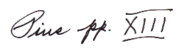
Pius, pp. XIII
August 3, 2004updated below section 2013
Those who wish to support the tcc Catholic Church (as seen in Us) may write checks payable to “truecarpentry";” to the new address at contact page, or to the old papal address. Or to the service address on truecarpentry website. As to what is easiest for us, please ask us in a email. We are not a tax deductible organization in the USA, so no deduction on your taxes can be realized when supporting truecatholic. Hence, the state cannot silence the truth that is in Us; about the true church. Upon doing this, please write tithes truecatholic at bottom left corner of the check's. Or, we will be forced to return them to its sender.

Top of Page |
Pope's
Homepage |
 Email
Email
to Papal Secretary |
 |