

2004 Catholic Calendar
You may order your 2004 Catholic Calendar from Missionaries of The Sacred Heart, P.O. Box 250, Clarksburg, OH 43115, and (740) 993-2189. The price which includes the postage is: 1-4 @ $5.50 each; 5-9 @ $5.00 each; 10 or more @ $4.50 each. For large quantities inquire.
Advent
The Church celebrates the beginning of the world until the birth of Jesus Christ with four weeks of preparation. God used the time from the creation of Adam until the coming of Christ to prepare the human race to receive the promised Redeemer. In like manner today, every individual is to use the time of Advent for a suitable personal preparation to receive special blessings from God on the feast day of Christ’s birth. Advent is a time of penance. The word penance may conjure up the thought of doing penance for one’s sins. There is much more to it than that. We shall copy from A Catholic Dictionary, Donald Attwater, imprimatur dated 1930. Those desiring to purchase it can get it from TAN Books and Publishers.
Penance
1. “Penitence, or repentance, a virtue disposing a sinner to hatred of his own sin because it is an offence against God (Who is all good in Himself) and prompting him to a firm purpose of amendment. The motive must be supernatural, consideration of the goodness of God and love for him, to distinguish it from natural remorse or fear. It is a necessary condition for forgiveness.”
2. Public. “The penitential discipline of the early Church relaxed after the 11th century, in respect of notorious and grave sinners, especially idolaters, murders and adulterers.” Attwater discuses at length this discipline, which is now no longer in use.
3. Canonical: “Prayers and good works, e.g. fasting, almsgiving, pilgrimage, retreat, imposed by ecclesiastical authority on those guilty of offences against canon law, either instead of, or to obtain release from, a penalty. Public penances may not be imposed for occult (q.v.) offenses.”
Every Catholic should observe the three canonical forms of penance according to his or her abilities to do so. We shall dwell on them briefly.
Prayer
Prayer is the lifting up of the mind and heart to God. There are four purposes of prayer. They are adoration, thanksgiving, expiation and petition.
Adoration (also called latria) is given to God alone. The creature must recognize that God is all-good in Himself, and for that reason He must be adored. Prayer may be vocal prayer, as when the family says the rosary together. Prayer may be meditative, as when one prayerfully considers the mysteries of the faith. In the saying of the Holy Rosary vocal prayer is united with meditative prayer, for one is to meditate on the mysteries of the rosary while he prays the Hail Marys.
By way of a further understanding prayer, We shall point out that veneration of the Angels and the Saints is tied up with the adoration of God, for what is honored in the Saints, is present in them, from God. Thus, God is honored when His Angels and Saints are correctly honored. There is a fine distinction that We must bring to your attention. The honor given to the Blessed Virgin Mary is called hyperdulia. She alone receives hyperdulia honor, which is above that given to the Angels and Saints. All the Angels and Saints receive dulia.
Fasting
The first thought that comes to us with the word fasting is the Lenten fasts, Vigils and Ember Day fasting. They are noted on the true Catholic Calendars. Also, abstinence is a form of fasting, but the penance is not concerning the quantity of food eaten, but it has to do with, not eating meat on certain days. The word fasting should be understood in a more, over all meaning. Any time one gives up something it is a form of fasting. One can fast from speaking by deliberately keep silence. During penitential seasons the faithful are to “fast” from having a solemn marriage. (A private or quiet marriage can be had, but not one with full organ and a banquet.) The faithful abstain from big parties (something hard to do while others are celebrating Christmas before the 25th of December). All men must always fast from bad shows in order to remain holy. The faithful abstain from many worldly celebrations during the penitential seasons. Smile at this one: stay away from bull fights and cock fights.
Almsgiving
Almsgiving is generally understood to be the giving of money, clothing, foodstuffs and the like to the poor. The poor you will always have with you. The poor need the well-to-do people to help them, and the well-to-do people need the poor to serve. Only those who have Christian charity do the penance of almsgiving as God demands. Take for example; hospitals are an invention of the Catholic Church. The same is true of orphanages, old folks homes and the like. Sisters and Brothers give their lives in the service of the poor. The faithful, in general, finance their charitable institutions. After bogus Council Vatican II, when the Novus Ordo bogus Church came into being, Catholic hospitals and other charitable institutions were turned over to laymen who were anything but Catholic. Let us just look at one such case. In Milwaukee, Wisconsin, the Catholic head of Miller High Life Beer built a hospital and put it into the hands of the Capuchins and Sisters to serve needy colored people. The needy received free and reduced rates on their hospital care. Once the Novus Ordo came into existence the Capuchins turned the entire hospital over to laymen, who then, charged one and all with their iron fist. Today, hospitals are closing up to the poor, for they cannot afford to pay a thousand dollars a day, and they cannot afford an insurance policy that will pay that absorbent hospital bill. Once again when saintly girls will become Sisters and saintly boys will become Brothers hospitals that serve the poor will come back into existence. They will be doing the spiritual and corporal works of mercy. Those who build the world around themselves have reason to fear for their eternal salvation. Here is what St. James writes about those who ignore the spiritual and corporal works of mercy. He writes: (James 2, 13) “Judgment without mercy to him that hath not done mercy.”
We take courage from St. Paul as We say a few things about Our life and Our works of charity. As a schoolboy in Catholic school We gave all We had, namely, fifteen cents to the missions. Not one other school child in the room (four grades together) gave a cent. We see from that, that We received the call to be a priest and a Religious (a Capuchin). After Our ordination to the priesthood We were assigned to a very difficult mission in southern Japan, called the Ryukyu Islands, and also some years in Australia as a foreign missionary. We performed full throttle for 21 years in Japan, and We converted many pagans. We built near fifty new buildings – Churches, hospitals, convents for Sister, schools for native and foreign children, a Capuchin monastery and the like. We could go on and on with the enumeration. After twenty-eight years in foreign missions We left the Novus Ordo, and without any superior We served scattered Catholics chiefly in the USA plus some trips to England, France and Australia. We drove about thirty-three thousands miles a year to visit and serve scattered Catholics from coast to coast. All this We did without ever taking up a collection. We lived as St. Francis urged his followers to do. We lived on the alms of those We served.
We lived and still live in notable poverty. For nearly 15 years, We lived in a small house with Our mother in Pittsville, Wisconsin. We cared for the house, cut the lawn, did Our laundry by hand in a sink, year in and year out. We always did and still do the cutting of our own hair. We mend Our clothing; sew on buttons and the like.
As many of you know We wrote, produced and mailed a newsletter for many years. We copied even large books and produced them for the faithful. We copied and produced very many devotional materials.
Over the years We administered the sacraments to many hundreds of the faithful. We have ledger books filled with records of sacraments given. They remain on hand to give certificates if they are desired.
Right now We live in very cramped quarters; office and bedroom are all in one. We have a good Catholic layman as our associate/assistant in the running of the residence. We help him here with cleaning and cooking. We set the table and clear it all the time. We do Our own laundry – always. We help Our home associate with cutting wood in the forest, and We carry Our share of it from the pile to the heater in the living room. We help stoke the fire day and night.
We have lived here for about two years, and We are helping our associate build a small living quarters. We stay on the job in heat and cold. We operate equipment such as cranes and the like. In the two years of building (and it is not finished yet) we do all the work without a contractor or day laborer, for we cannot afford to hire one.
We could recapitulate from Our twenty-eight years of foreign mission service. We worked on the job, building about fifty mission building. We served on foot distant places in the mountains and along the sea. We instructed as a catechist many hundreds of catechumens from paganism. We preached daily at Mass for years. The monuments of Our foreign service stand as a testimony of Our spiritual and corporal works of mercy, and it also secretly tells you that devout faithful financed Our many operations.
By divine providence God guided Us around the world visiting the Holy Land, Rome, Lourdes, Fatima and Guadalupe. We could tell you for the glory of God the many times God stepped in to save Our life. We give glory to God for the following divine care. On a vacation from the missions (from Okinawa to the USA) We had a stop in Hawaii. The flight company had the passengers wait in the terminal all day long while they repaired the plane. In the evening after we were in the sky they told us that the flight would go to Los Angeles, not to San Francisco as scheduled. The mystery of that change of flight came to Us in Los Angeles. After We had Our ticket changed to another carrier We stood at the window looking that the planes beside the building. The plane that carried us was still next to the window. A starter generator pulled up the plane, and they tried to start the plane in order to move it away from the parking area. Mind you, they did all they could to start one motor after the other, and they failed to start even one. The plane had to be towed away. All We could think of was that God kept that Junker plane in the air to save Our life, with the equivalent of four dead engines. We shall not burden you with numerous such acts of divine providence, especially in the many shipwrecks at sea that We encountered.
The reason We have extended this account is to inspire one and all to become involved in the practice of the spiritual and corporal works of mercy. This is not to be done as just do-gooders. Atheists, and every ilk of Protestants, can do some works of mercy, but not for an eternal reward. Note that they say, if you give to the March of Dimes you will feel good (be rewarded now).
We have developed the steps needed to do the spiritual and corporal works of mercy where one gains an eternal reward in heaven. One must have sanctifying grace. Then ask the Holy Ghost for an increase of the virtues of faith, hope and charity: for prudence, justice, temperance and fortitude. Then ask that all those virtues may be perfected and bolstered in their operation by wisdom, understanding, counsel, fortitude, knowledge, piety and fear of the Lord. One must accede to the hardships of the eight beatitudes. Then one must perform the spiritual and corporal works of mercy in the spirit and in the practice of the evangelical counsels of poverty, chastity and obedience.
God makes it that each person is to sanctify himself in his God given vocation. A married person should not say, I could be better if I were a Religious. No, God has you in the married life, and in that state alone you must work out your eternal salvation. No matter how great ones duties, in his vocation, may be he will never do more for his advance in holiness than live his vocation as God demands. We, as Pope, cannot give up Our spiritual practices because of the enormous workload. We will sanctify Ourself only in proportion as We perform Our duties as Pope. There is never any true clash between one’s vocation and one’s obligation to work for an increase in grace and merit. The degree of reward in heaven will depend on the amount of sanctifying grace and merit that one has at the moment of death.
In conclusion: We urge one and all to not just live in idleness, in sanctifying grace. Every moment of life must be used to further ones spiritual development, for an every higher reward in heaven.
God gives to some the special calling to live a life that has in its particular state, the constant performance of the spiritual and corporal works of mercy in the spirit and practice of the evangelical counsels of poverty, chastity and obedience. Right now divine faith is so weak and the faithful, young and old, just ignore that call. Is it rash to say what seems to be the truth? Shame on the lukewarm Catholics today, for there is not one Sister or one Brother giving glory to God and saving souls. Religious should be the gems of the Catholic community. The faithful should be supporting their efforts to serve the poor in hospitals, to serve the Catholic children in Catholic schools, to bolster foreign missionaries with prayer, fasting and almsgiving. The Mystical Body, the Church, is here, and We as Pope feel as if We, the head of the Mystical Body, are without arms and legs. Lest We sound ungrateful to those who support the Church with their widows mite We tell you that God Who sees in secret knows all the works of mercy that are performed by the scattered Catholics, and He will reward them in all justice and love.
It is possible that We live in a similar time spoken of by Our Lord as recorded in Luke 18, 8: “But the Son of man when he cometh, shall he find, think you, faith on earth?” After the flood, God continued human life on earth only in those who rode out the flood in Noe’s ark. Likewise, God will find the life of sanctifying grace only in those who ride out this time of crisis of faith, living in God’s one, holy, catholic and apostolic Church. Those not in the Church will be out in the exterior darkness where there is weeping and gnashing of teeth forever. Our call goes out to every human being on earth to come to the harbor of truth and the unity of faith.
Virtue of Hope
One of the brethren asked Us to say something on the virtue of hope. First of all, the virtue hope comes to one when he is baptized, together with the other two theological virtues of faith and charity. Hope works normally only when both faith and charity are in the soul. Hence, a person with mortal sin is lacking the virtue of charity, and the other virtues sort of become numb with very limited powers. By heresy one also loses faith. By despair and presumption one loses hope. Indeed, any soul is in a most lamentable condition when he is devoid of faith, hope and charity. He no longer seeks forgiveness and grace, and at best he is lukewarm. Of the lukewarm Christ said He would begin to vomit them out of His mouth. Think how terrible those words are. No one ladles back into his mouth and swallows his vomit. God made man as a natural creature, and at once He elevated him with sanctifying grace. That made man like unto God in the supernatural order. Without that likeness God cannot love any creature – be he an angel or a man. Man must be elevated by sanctifying grace in order to live in heaven, for being in heaven means that one belongs to the family of God. All children are like their parents. An ape can never (where common sense reigns) become a member of a human family. An ape-like human being has no place in heaven. Hence, one must always be in sanctifying grace, so that, no matter when one dies he will go to heaven.
Putting aside despair and presumption the gifted person with the virtue of hope, hopes for forgiveness when necessary and for a continual increase in sanctifying grace and merit. God’s working in souls is really a mystery. We hope for forgiveness and grace because God promised those things to those who do His holy will.
Here is the theological foundation for hope. The virtue and function of hope depends on two qualities (humanly speaking) in God. First of all, one hopes for grace and the reward of heaven when he obeys God. In all honesty God promises forgiveness to repentant sinners, and He promises an increase in sanctifying grace and merit to those who do the works He commands. A second quality in God (humanly speaking) is that He is almighty. Hence, there can never be a time when God is powerless to give what He promises.
Hope is lost when one falls into the vices of despair and presumption, which are sins against the Holy Ghost. By despair one says that his sins are so great that God cannot forgive them, so he does not make the act of contrition to recover sanctifying grace. If he should overcome his despair he could receive forgiveness and sanctifying grace again. The same is true of presumption. The person with presumption has a mindset that he can put off seeking forgiveness and a return of sanctifying grace. He presumes that he can enjoy his sinful life until just before death, and then he is determined to seek forgiveness and a return of sanctifying grace. As a matter of fact it is not likely that he will know when he is dying, and even if he does know he is dying he is not likely to seek forgiveness.
Some people are confused about the elements of forgiveness. A person can say the act of perfect contrition with a heart full of pride, and he may be denied forgiveness and sanctifying grace. Here is what is said in James 4, 6: “God resisteth the proud and giveth grace to the humble.” In short, every act in order to be worthy of forgiveness or an increase in sanctifying grace must be preceded by, accompanied with and followed by actual grace. Woe to the person who by his pride closes the flow of actual grace from himself. Even on this earth he is equal to the damned in hell. Just imagine the sign over the gate of hell: those who enter here never have any hope.
With a salutary fear, all of us must work on our eternal salvation, ever cooperating with the graces God gives in abundance to the meek and humble of heart. The lukewarm and the proud have every reason to fear eternal damnation. Consider again what is recorded in James 4, 6: “God resisteth the proud and giveth grace to the humble.” Truly, it behooves one and all to pray in all humility the following prayer: Jesus, meek and humble of heart, make my heart like unto Thine. This ejaculation is taken from the Roman Breviary, and it is indulgenced with a 500 days indulgence every time it is said. (Raccolta #227) Just think of the good you can do for yourself and for the liberation of souls in purgatory by the frequent (yes, habitual) use of the ejaculation: “Jesus, meek and humble of heart, make my heart like unto Thine.”
We wish all of you a blessed Christmas and a grace filled new year. All for the greater honor and glory of God.
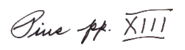
Pius, pp. XIII
December 10, 2003

Top of Page |
Pope's
Homepage |
 Email
Email
to Papal Secretary |
 |