

Caritas - Papal Office
by His Holiness Pope Pius XIII
March 1, 2003
Retreat Meditation
Those who still remember how the Church functioned before bogus Council
Vatican II must remember that from time to time the parishes had
what is called a “parish
mission.” The parish was prepared for the coming mission by announcements
of the time and a request for special prayers for the conversion of the
fallen away and lukewarm Catholics of the parish. The pastor cares for
the faithful
by his providing Mass, sermons, and general direction of the parish. Even
with that zeal, there would be some souls falling away from the Church,
and others
coming closer to a fall by their lukewarm practice of the faith.
First of all, the pastor does not preach the parish mission. It is preached
by a priest or priests who prepare for this very special work. We are
from an Order,
the Capuchin Order, which was always engaged in this work of parish missions.
In fact, as a boy of about eleven, We had a parish mission given by a
Capuchin priest, no less than an exorcist priest, the one who drove out
the devil
from a woman in Earling, Iowa. You can read that record of history by
purchasing the book entitled “Begone Satan” available from
TAN Books and Publishers. When that priest, Father Theofulus, thundered
divine truths
in his sermons
there was silence as in a tomb in the Church. He so impressed Us that
We remember him
just as if he preached to Us yesterday. After the sermons he used to
pray before the Blessed Sacrament with outstretched arms, and the parishioners
prayed with
him in silence. It was right about that time that We felt the call to
become
a priest, and who knows but it could have been at that parish mission
that God gave Us Our call to serve Him in the priesthood.
During the parish mission the missionary spent hours in the confessional.
It is likely that people who had neglected their Easter duty came back
to the zealous
and frequent reception of the sacraments. The missionary visited the
homes of parishioners who had left the Church, and he brought them back
to the
practice
of their faith.
We shall note that the sermons of those missionaries are so powerful
and soul-stirring that the scrupulous parishioners are told not to attend
the
services. They my
get so disturbed that they will want to confess their sins over and over
and for hours. Prudence requires that they be not put through such a
terrible soul
suffering, something that is their personal problem and cross.
Before proceeding with this meditation We will inform you that as soon
as the Novus Ordo came into place, parish missions became a matter of
history. We
shall not say that they were all shut down, but the powerful preaching
no
longer continued.
The new parish missions became all sweetness. The preaching of hell was
forbidden. On one Sunday in Australia when We assisted there, with no
parish mission
in progress, We preached a strong sermon on hell. Our superior called
Us to task
and forbad Us to preach on hell. The Novus Ordo Church was eliminating,
step by step, the very concept and traditional teaching of hell. Nearly
every
Novus Ordo prayer card given out at funerals stated and still states,
in effect,
that the deceased person is right now in heaven. Furthermore, the faithful
are told
that it is only a matter of time before they will be in heaven with the
deceased: “Oh
how wonderful; do not cry!”
True Catholic catechisms teach that it is most profitable for salvation
to meditate on the “four last things,” namely death, judgment,
heaven and hell. St. Francis of Assisi urged his Brothers to preach a
good balance
of punishment
and reward.
Mission Sermon on the 4 Last Things
“The fear of the Lord is the beginning of wisdom.” There
are two fears of the Lord. One is slavish fear, and the other is filial
fear.
Both fears have a place in our eternal salvation.
When, in the course of divine providence, our lives on earth are over
we must die. God gives us time to prepare for death from birth until
death.
The only
reason for being on earth is to prepare daily, yes, every moment, for
the coming event of our death. We should look at death this way. We
are certain
of death,
but generally we have no idea when we shall die. Every moment of life
on earth is a special gift of God. If we live our lives as God demands
we
will not waste
a moment of time. Time is so valuable that all the efforts of men cannot
give us a moment of time. It comes from God. Time is so valuable that
with it we
can avoid hell and gain heaven, that is, if we do the will of God.
During life we either go higher or lower in grace and merit. An old
priest used to tell his people that life is like a person in a canoe
in the
middle of a running stream with a waterfalls downstream. If the rider
in the canoe
neglects to put his efforts to the oars the water will take him downstream.
Hence, only those who exert effort on the oars stay in the same place
or, better still, go upstream. Evil persons row their canoe downstream.
Oh,
that is so
easy! Oh how certain is the coming progression towards the waterfalls
of perdition! The lukewarm have their canoe turned upstream, but
they do very
little worthy
of eternal reward. Without knowing it they live in a fool’s
paradise of blind ignorance. They are not concerned about the coming
catastrophy
of falling down the waterfalls to eternal perdition. They let their
conscience atrophy. They have no fear of hell, nor do they desire
the joys of heaven.
They have no motives to avoid evil, and they have no motives to prepare
for
heaven.
Let us consider time and everlasting life. At the moment that a person
is conceived he begins his everlasting life. His natural life of
the soul will
never end
even if he dies a minute after conception. Of course his body will
also continue forever. On the last day the body will rise to be united
with
the soul that
is waiting for its resurrection. Consider this, you are right now
living a portion of you never ending life. Once again, the purpose
of your
life from
conception until death is to prepare for your unending life in heaven.
God gives every individual all that he needs in order to make it
to heaven. Hence,
those who are lost, seeing their just judgment, must say forever, “I
am here because of my own fault.” Likewise, the just must say, “I
am here because I cooperated with God in the work of my everlasting
salvation.”
Since God is all-knowing (knowing the past, present and future of
created beings) He knows right now who on earth will actually cooperate
with
Him and who will
not cooperate with Him. Hence, on earth there are right now two classes
of souls, namely, those whom God knows will go to heaven and those
whom He knows
will go to hell. Those who will go to heaven are known as God’s
elect. God has a special care (a special providence) for His elect.
Those who
refuse salvation are cared for God, lest they blame their unending
and just damnation
on God at judgment day.
After death and forevermore, both the just and damned continue to act
exactly as they were acting at the moment of death. In effect the just
were adoring
and praising God. Also in effect the damned were defying and cursing
God.
The just see that they are God-like in sanctifying grace, so they
belong to the family of God. They can enjoy the beatific vision forever.
The
damned see
that they are dirtied with mortal sin, and therefore they do not
have the life of sanctifying grace. Hence, they can never ever see
God face
to face
in the
beatific vision. This angers them, and they curse God actively and
forever. They tell God unceasingly “I hate You, and I hate You forever.” God
responds, “That is your decision and activity, and I punish you in hell
forever and ever.” The cursing of the damned and the punishment
of God scroll side-by-side forever. The damned know it. Their punishment
will
continue
forever. It will never end.
Some people think that the damned will repent, but that will never
happen. They actively curse God forever, and that brings the just judgment
of
God on them, similar to effect of their cause.
Just imagine the impossible. If the damned were permitted a place
in heaven they could not enjoy the beatific vision, for the beatific
vision
presupposed
that the soul has the divine life of charity through sanctifying
grace. He would be like a man blind and deaf at an opera, grinding
his teeth
because he cannot enjoy what he knows is going on before him. The
only future for
the damned is what Christ called, the darkness outside where there
is the “weeping
and gnashing of teeth.”
Spiritual books have many examples of how terrible hell really is.
Over and over, from the time We started to hear sermons in Our parish
church,
We heard
the following story:
In Monasteries when there is a funeral the Monks gather before the
Mass, with the coffin present, in Church, and they pray the Office
for the
Dead. On one
occasion, as they began the Office of The Dead the somberness of
the recitation of the Divine Office was broken by a movement in the
coffin.
The corpse
rose up a bit, and with a voice sounding as one coming out of hell
it said: “I
have been judged by the just God.” The Monks were shocked, and they had
a discussion. Should they continue the Divine Office or not? The conclusion
was that the corpse (the terrible voice) merely said: “I have been judged
by the just God.” He did not say that he was damned. Then the Monks continue
the Divine Office as usual. After a short time the corpse once more rose a
bit, and from it came the terrible voice again: “I have been judged by
the just God.” The Monks were amazed, but once again he did not say he
was in hell. As they continued the Office for the Dead the man in the coffin
cried out again, “I have been judged by the just God, and I am damned.” With
that testimony the Monks felt forced to stop the public prayers for
the dead and the Catholic funeral for the dead. The same fate awaits
all
those who
die in mortal sin.
We could continue with some stories of the deaths of the Saints. It
is reported in the lives of the Saints that when St. Scholastica, the
sister
of St. Benedict,
died they saw her soul go to heaven as a white dove.
We feel that much good is had by a consideration of the fact that we
never know when we shall die. As we live, any heartbeat can be our
last heartbeat.
Just think of all the people who die without warning. They are shot,
ran over by cars, cracked up in plane crashes and the like. Death comes
as
a thief in
the night even when we die slowly. The dying know not the moment when
their conscious mind ceases to function, just as we know not when our
conscious
mind ceases to act when we go to sleep.
It is important that every human being be in the state of sanctifying
grace every moment of his or her lives. Once one has been baptized
he can have
only one of two states of soul, that is, being in sanctifying grace
or in mortal
sin. It is possible that one be in sanctifying grace and still has
temporal punishments to perform. That will be completely accomplished
in purgatory.
Hence, those in purgatory all eventually go to heaven.
The question of unbaptized persons comes up. Original sin remains in
the soul where no baptism is given, until the person makes his determination
to serve
God with an act of perfect love or turn away from God with mortal sin.
That determination is likely made right at the time the person gets
the use of reason.
Before that he can neither sin nor do acts of virtue. A valid baptism
of
water takes away original sin and gives sanctifying grace. Hence, after
baptism and
after the first determination is made, all men are either in sanctifying
grace or in mortal sin. There is no state other than those two states,
and one state
takes the person to heaven and the other state takes him to hell.
Lest there be confusion on this point We shall clear up the question
of the “limbo
of the infants.” If a person who dies as he is created in original
sin, he dies without sanctifying grace, that is, without the supernatural
life of
grace or charity. Hence, he cannot go to heaven. In hell there are
two parts. Once is for those who die in mortal sin, and another is
for those
who die
in original sin. The hell for those who die in mortal sin has much
suffering. However, those who die in original sin do not suffer,
but they lack the
beatific vision of God forever. The Fathers of the Church without
apologies merely
say
that the unbaptized that die that way are damned souls. Hence, you
see the reason for the Church making the law that infants must be
baptized shortly
after birth, that is, within two weeks of birth, and if danger of
death is seen before that time, baptism must be given immediately.
God made
it that
every normal human being has the power to confer the valid sacrament
of baptism of water. In this treatise We shall not deal with that
procedure.
It is absolutely amazing to Us how people consider themselves safe
and sound on the way to heaven. We know a person who converts people
over
a large part
of the world without any attachment to Pope, Bishop or priest. For
her getting to heaven means being baptized and living a good life – finished.
The Russian and Greek Orthodox think that getting to heaven means that
one is safe if he is subject to some Orthodox Patriarch. Since bogus
Council Vatican
II all imaginable forms of Christianity have surfaced. It is impossible
to deal with all or even the most obvious sects. However, the largest
blundering group belongs to all those who believe that going to the
Latin Mass will
get
them to heaven. Some groups have bishops, and others have merely priests.
They are without a Pope, and are content in that condition.
Christ gave the basic command that all men (and all states) in order
to be saved must be in His one, holy, catholic and apostolic Church.
The Fathers
of the Church expressed it in this short formula: “Outside the Church
there is no salvation.” The Church has never veered from this
dogma. Believe it and follow it or be damned.
A starting point on the way to heaven is faith. Without divine and
catholic faith it is impossible to please God; it is impossible to
get to heaven.
Faith does not stand along, for hope and charity must also be had in
order to be
saved.
We come upon persons who laugh Us to scorn for stating the above
dogmas. They should consider the world at the time of Noe. The Fathers
of the
Church instructed
that just as all were lost who were not in the Ark, so all those
who are not in God’s Church, the Catholic Church (now under
Us) are all lost.
The above paragraph may stir up a furor, so We shall state briefly
that being in the Church while not being a member of the Church (by
baptism
of water)
is a thing that is known for sure by God alone. A catechumen who knows
the faith and is determined to become a Catholic can enter (be within)
the Church
by an act of perfect contrition or perfect love. Once again, he is
in the Church, where alone there is salvation, but he is not a member
of
the Church
until
he receives the baptism of water.
Just where is there guilt in regard to not being in the Church by
baptism and not being subject to the Pope? God in His infinite knowledge
of
hearts knows
this for each person. Anyone who avoids being a Catholic because
he does not use the graces God gives him, cannot claim to get to
heaven
merely
by the act
of perfect contrition. Why is that? It is because his act of perfect
contrition is not perfect without an act of obedience God places
on him. That act
of obedience is found in the dogma (God’s command):
“Outside the Church there is no salvation.”
Smart as they may have thought themselves to be, all
those who remained “outside” the Ark of Noe were lost,
and so it is with the Church. All those who die outside of Her (and
are responsible
for
it) will be lost.
Our Lord gave the parable of the man who hired men to work in His
vineyard. At all hours of the day he found men idle. He sent them
to work in
his vineyard. How do we understand idle? It is: not working for the
wages
of heaven.
First of all, all those who are not in the state of sanctifying grace
are idle. No matter how good they are, and no matter how wonderful
their lives
are they
are idle, not working at all. While one is without sanctifying grace
(those in original sin and mortal sin), there can be no supernatural
reward for
anything that is done. One is simply unemployed in the work of his
salvation.
We shall consider the gaining of merit for a heavenly reward once
one has sanctifying grace. Besides sanctifying grace one must do
some honest
work,
and to that
work must be attached two supernatural qualities. One must do his
works for a supernatural motive and under the influence of (supernatural)
actual grace.
All these four elements must be present and function at once.
The supernatural motive is this. The act is done for the honor and
glory of God and the salvation of souls in some form. To work just
to have
food on the
table will give no supernatural reward, for that motive is a natural
one, and it is unworthy of a supernatural reward.
The supernatural assistance is actual grace that helps one do good
and avoid evil. If that divine power is not employed in the otherwise
rewardable
act
it is useless for a supernatural reward, and the person, to say it
again, is idle, wasting his time, and not improving his position
for a heavenly
reward.
So that you can remember these necessary elements We shall repeat
them. For any act to be worthy of a supernatural reward the person
must
be in
- sanctifying grace,
- do an ordinary good act,
- for a supernatural motive, and
- under the influence of actual grace.
It was related to Us as a true story that a Pope had a wax image of himself made and put in a coffin resting in his residence, as being ready for burial. When a visitor saw that object he remarked to the Pope, “Why do you have such an ugly thing in your residence?” The Pope replied, “Whenever We have an important decision to make for the Church and even Our personal life, We come here and contemplate what decision will be best for Us at death. To date We have not regretted any decision made in that way."
Dear reader, you can do that same thing in imagination also.
The contemplation of one’s death has made many people
zealous for the good. The non-Catholic will convert. The Catholic
will
really
make his faith
practical. He will
support the Church in all Her works by supporting the clergy,
building and maintaining
hospitals, orphanages, soup kitchens and the like. Vocations
to the priesthood and religious life will also flourish.
Today We live in a time when God is permitting men to hang
themselves. The author, Haydock, quotes the Fathers of the
Church who explain
the words in
Isaias 13, 10: Matthew 24, 29: & Mark 13, 23 “the sun will be darkened
and the moon will not give her light,” where the sun
is God and the moon is the Church. All those who permit themselves
to
be lax in
the practice
of
the faith will freeze in spiritual death just as surely as
a
person who permits himself to sleep poorly clothed in a below
zero cold
place.
Which one of the following sentences will each one of us be
forced to say, by the command of the just God, from our coffins? “I
have been judged by the just God and I am in heaven,” or “I
have been judged by the just God and I am damned?” Amen.
Lord,
make me an instrument of Thy peace;
Where there is hatred,
let me sow love;
Where
there is doubt, faith;
Where there is despair, hope;
Where there
is darkness, light;
and where there is sadness, joy.
O Divine
Master, grant
that I may not so much seek to be consoled, as to console;
to be understood, as to understand; to be loved as to love;
for
it is
in giving that
we receive, it is in pardoning that we are pardoned, and it
is in dying that we are
born to eternal life.
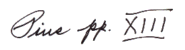
Pius, pp. XIII
March 1, 2003

Top of Page |
Pope's
Homepage |
 Email
Email
to Papal Secretary |
 |