

Caritas - Papal Office
by His Holiness Pope Pius XIII
August 12, 2002
Beautify – Uglify
Heaven – Hell
When that order is reversed nothing but chaos follows. This can be illustrated with a concrete example. When We entered the Capuchin Order, during the rule of Pope Pius XII, the dictum and practice was that the younger Religious, those under thirty, were to stay out of the ruling of the Order. That was the work of those over the age of thirty. When the modern revolution, the Novus Ordo, took place, the following mantra came into place, saying: “When you are thirty and above you are an old fogy unworthy of attention.” A classmate in the Order commented thus: “I was deprived of having anything to say in the ruling of the Order while I was under thirty years of age, and now that I am over the age of thirty I am deprived of having anything to say in the right government of the Order because I am labeled an old fogy. The effect is that the Order was spared my immaturity, and now it is deprived of my maturity.” What happened after the shift? The Capuchin Order sold nearly all of its houses of studies and its novitiate house because there were practically no more vocations. That was typical of all the Orders in the Church. That was typical of all dioceses, namely, the closing of parishes, schools and so forth. The Novus Ordo has done it destruction and continues to do so.
Before any real corrections can be made, principles of action must be place before the minds of our younger generation. In proport-ion as the younger generation cooperates with the graces of God it can elevate this society under the guidance of the Catholic Church.
Uglification Must Give Way to Beautification
While Christendom was at a high level, art in all fields rose to great heights. The cathedral of Cologne was so large and artistic that it took eight hundred years to build. Possibly now it would fall into total ruins if it were not that it, like so many beautiful buildings, is an historical monument, which brings numerous visitors and much financial wealth to the area. There was a time when one could find the Churches in every American town by just looking around for the most beautiful buildings, which also had a bell-tower, topped with a cross. The walls were ornamented with beautiful stained glass windows, which depicted beautiful pictures the Saints and the Mysteries of the Catholic faith. The new Novus Ordo Churches generally are shapeless squat building similar to bowling alleys or skating rinks. Just looking at those buildings a visitor to the town will not suspect that they are Churches.In the Middle Ages when Europe was generally Catholic, one found the most beautiful works of art in the Churches. They had large and gorgeous altars with decorations and statues of the highest quality as to production and the choice of colors. At Holy Week, a Side Altar was decorated to command awe and lead the faithful to adoration of Our Lord in the Blessed Sacrament. At Christmas a large Christmas crib with well-painted figures graced a prominent place before a side altar niche. The art was so commanding that it drew the visitor to fall on his knees to join the shepherds in profound adoration.
Anyone who ever had the privilege, as We had, to visit St. Peter’s Basilica in the Vatican, must remember for the rest of his life the profound influence that the Pieta sculptured by Michelangelo had on him. One is profoundly drawn to adore with great reverence the crucified Body of Our Lord, Jesus Christ, resting on the knees of His Blessed Mother, Mary.
The Novus Ordo with its heretical mentality not only makes ugly Church buildings but it also makes ugly artifices within the Church. It went hell-bent at destroying the Catholic art that had graced the Churches for centuries. In many parishes the figures in the Christmas crib were covered with white paint, thus losing their paint art and with it the devotion that went with it. In Our parish the main altar was removed, and the sanctuary was made into a choir room. The altar was placed to the left of main room of the Church without elevation right on the floor, and its shape was that of a meat block facing the people. On an Easter occasion that We saw the desecrated Church interior, there was an ugly dead tree, being of course without leaves, standing beside the meat block altar. The tree was decorated with Easter Eggs. Nothing in the Church except the old stained windows commanded the least bit of awe or devotion. We also noted that the building was treated as just another meeting hall where the Novus Ordo Catholics gathered for social meetings.
New Way of Dressing
Dear young readers, did you ever hear the expression, Sunday Suit? If you can find an old picture of Catholics at Mass you will see that every man was dressed in a suit, dress shirt and necktie. The women came to Church modestly and elegantly dressed plus their heads were covered with a hat. What has happened? Men began to wear shorts, open neck shirts, and tennis shoes to Mass. Women began to wear immodest and ugly dresses. Degradation just could not stop. Both men and women chose the lowest type of cloth for pants, skirts, and coats and even overcoats. They went in for the mod cloth called denim. In former days denim was used on the farm for hard work. Likewise, railroad workers and construction men had clothing made of denim. Never did any of them think of going to Church in their working clothing. What they wore was their Sunday suit. They could be as poor as Church mice, and still every male had his Sunday suit and every woman had her Sunday dress. In more recent times, immodesty and lowbrow dress became so terrible that on one occasion We had to deny a lady Holy Communion when she was at the Communion railing.Lowering to the condition of baboons just knows no limits. Skirts became so short that they were only inches away from the infamous bikini. Ugly looking Church buildings, ugly decorations inside the Churches, ugly dresses on the faithful and finally ugly musical lyrics and music made the perfect combination for the faithful to tell God they no longer cared to give Him any honor and glory. God does not hamper the free will of men on earth, in heaven and in hell. The Saints in heaven freely obey and adore God without ever changing their minds. The damned in hell freely disobey God and hate Him forever, always doing what they damn please. All men on earth, day by day, get ready for their never changeable condition in heaven or hell.
Christian Art and Culture
Possibly the greatest piece of Christian Art in sculpture is the Pieta by Michelangelo, now protected under a protective glass bubble in St. Peter’s Basilica in the Vatican. It is so devotionally commanding that the observer feels drawn to kneel down and adore the Crucified Lord resting in the arms of His beloved mother. Generally it is accepted that the greatest piece of poetry ever written is the Dies Irae found in the Requiem Mass. For the ordinary man, the greatest music is found in the Plain Chant. We have even seen pagans in Japan stop in their tracks when a radio program happened to play that music.We go to St. Thomas for a definition of art. He says: “Art is nothing other than right reason of some produced works.” Before the time of Christ Aristotle defined art as follows: “Art is the imitation of nature.”
The first and necessary condition of fine art is that it be ordered with symmetry, splendor, harmony and so forth. For example, a face with one eye lacks completeness. A face with the nose that is crushed is ugly. Scars likewise mar completeness. A man dressed in pants that is four sizes too large for him and four inches too long fails the test of art also. It even falls lower on the scale of ugliness if the pants are made of denim or similar workingman’s rough clothing materials.
Scholars in the treatment of art tell us that a good character in the artist is necessary for the production of art. Christian art cannot be produced by a skillful painter unless he has the Catholic faith. Have you ever spent time looking at the works of art now being produced by the Russian and Greek Orthodox? They like to use the ancient Catholic icons, and yet they are unable to produce new ones. Their sterility in art will continue until they embrace the Catholic faith, from which they have fallen. The same is true with the Novus Ordo. Their magazine covers (when newly produced) come out bland, that is, without devotion, spirit and life.
Our Lord said that a bad tree cannot bear good fruit, and a good tree cannot bear bad fruit. By their fruits you shall know them.
The question may come up, but what has art to do with the spiritual life. We really clued in with Our explanation of the Pieta by Michelangelo. Christian art is an expression of faith. The objects of art can be images of Our Lord, the angels and saints. They can be images of God’s creation, as a sunset. The author sees the marvels of God in the sunset, and he brings out his admiration and love for God the creator of nature, in that beautiful sunset.
Once a man of faith and artistic skill produces a piece of art, that production leads men to the faith and keeps them in the faith. Hence, the Church wants works of art also in the homes of Catholics. A child who grows up with ugly pictures of hippies and “rock stars” on the walls and ceiling of his or her room will have such mindless and evil thoughts. Such a one can easily lose the faith. However, the child who has pictures and statues of Christian art in his room is likely to develop well in the Catholic faith. Filled with devotion, he will fall down on his knees before the Catholic pictures. However, those who have the sexy pictures of their passion heroes in their rooms will be like them. They will become like the non-Catholic world, just so many airheads dripping with sex.
Catholic Culture
The word culture basically comes from the word cult. Cult means worship. In the Middle Ages in Europe they had a Catholic culture. Many villages had the Catholic Church in the middle of the village, and it was centered as the center of a wheel. The faithful could just step out on the road, face the middle of the village, and he had before him the Catholic Church. The pagan Romans made the Coliseum in Rome the center of their lives. Their sadistic pleasure was seeing animals and men butchered before them. On Okinawa, on a Sunday afternoon you see hillsides crowded with people watching bullfights. The Aztecs, pagan Indians in Mexico, had human sacrifices. Every twenty minutes in the day, the year around, in several locations in the land, by government orders, the Aztecs cut the belly open of a young man, pulled out his heart, and chewed at it. When the body was thrashed out of life it was kicked over the ramp, and at night the people cut off the arms and legs, which they brought home for food. All these things come under culture – their worship. Once Our Lady of Guadalupe brought heavenly graces to that pagan land, it became a Catholic land, and the cult of venerating the image of Mary struggled to take the place of the serpents of former days.Faith and art in literature also is most important for a Catholic culture. St. Alphonsus de Ligouri, a vessel of election, was a doctor in Civil Law and Canon Law by the time he was sixteen years old. He became a priest and bishop, founded a Religious Order, lived to be nearly a hundred years old, and wrote about one hundred books. A favorite booklet of his (now sold by TAN Books and Publisher, Inc.), called “Uniformity With God’s Will” impressed him so much and lead him in the spiritual life so well that he continued to read it until he became blind, near the end of his life. Then he had others read it to him. In Our spiritual life, We also develop prayers and devotions that We follow in the same way, as did St. Alphonsus. Once again, faith causes one to write the things of faith, and then the author assists others in the practice of the faith.
Practical Conclusion
A person’s thinking and believing must of necessity express itself in external words and actions. Those having the true Catholic faith with Us must show by words and actions what we are internally. Then others seeing that, can be converted, and a true Christian order can come into the world. Turn to divine revelation in Matthew 5, 16 where Christ speaks:“So let your light shine before men, that they may see your good works, and glorify your Father who is in heaven.”In Our homes We must surround ourselves with sacred statues and picture of the highest artistic quality. The music we listen to must be both common sense secular music and liturgical music, which is published with an imprimatur. Such music as rock music must be forbidden entirely. We counter such evil things by telling one and all the sources of excellent literature and music. Parents must see to it that such mindless books as novels be restricted merely to what school courses may require. As children advance in age their knowledge of the Catholic faith is to be deepened by catechisms that are more developed with each successive year, until they have advanced into such wonderful and detailed books as “The Spiritual Life by Tanquery” and “The Catechism Explained” by Spirago-Clarke. Let Us put it this way. By a special act of divine providence those two advanced catechisms are right now available from TAN Books and Publishers, Inc. Rockford, IL. Over the years We copied the 1880 edition of Goffine’s Explanation of the Epistles and Gospels. Now the Angelus Press, 2915 Forest Ave., Kansas City, Mo 64109-1515 has it for sale, entitled, “The Church's Year.” Reading such a book at least on Sundays will not only enlighten the mind, but it will also inflame the heart to love God ever more and more.
We are anxiously waiting the day when some of Our Catholics will join in an effort to publish a monthly Catholic magazine covering updated materials on the knowledge of the faith and the practice of it. We have the fond memory that Our mother always purchased a fine monthly Catholic magazine, which she read with devotion.
To all Our readers We give this reminder. All of us are children of Adam, and therefore all of us have the sin and weakness of original sin. One day St. Francis of Assisi saw a criminal being lead out to be hanged. St. Francis said, “There, except for the grace of God, would be Francis.” It is only by working with grace that any of us can become better than the worst persons on earth.
Those who live ungodly lives uglify themselves and the world around them, and they bring that ugliness with them to hell. Those who live godly lives glorify themselves and the world around them, and they bring that glory to heaven to be enjoyed unchanged forever.
A Study -- “The Fear of the Lord”
One of the first steps onto perdition that the Novus Ordo religion of bogus Council Vatican II made, was to remove from the minds and hearts of Catholics the supernatural gift of the Holy Ghost, known as “Fear of the Lord.” Preachers deliberately told their eager audiences that the era of fear is over. We serve a God of love. He knows our weaknesses, and He will not punish any sin with unending sufferings in hell. With that plague making people spiritually sick, all priests were forbidden to preach that hell was painful and that it would last forever. We were slow in catching on that this trend was mandatory, and We kept on preaching that hell is dreadful and that it will last forever. Finally, Our superior (when We were only a priest) called Us in, and he made it clear in no uncertain terms that We were no longer to preach that hell was dreadful and that it is going to last forever.Just what is involved in the gift of the Holy Ghost called: “Fear of the Lord?” Since it is a gift of the Holy Ghost it has to be sought, and in order to live the Christian life one must cooperate in the function of “fear of the Lord.”
The learned and spiritually sound author, Father Edward Leen, C.S.Sp., in his last book before his death, entitled: Grace and the Supernatural, writes:
“Fear (of the Lord) replaces the cautious dictates of the human reason by the exigencies of the good pleasure of our heavenly Father.”One word in that definition may cause confusion since it is not used frequently. It is exigencies. The dictionary gives the following: exigency: urgent want: case demanding action or remedy, requirements. Exigent: requiring immediate aid or action.
God gave us our human reason (a natural faculty) so that we can judge what is good or bad, what is needed or what is not needed. However, natural human reason is wide open to errors. It needs the virtue of “prudence,” which is given at baptism with sanctifying grace. That virtue is lost with mortal sin. Above the virtue of prudence, the gift of the Holy Ghost called “counsel” is given. A further right judgment is given by the gift of the Holy Ghost called “Fear of the Lord.”
Please note how lonely and weak natural human reason is when compared with that same natural reason which is perfected and bolstered by:
- the supernatural virtue of prudence,
- the supernatural gift of the Holy Ghost of counsel and finally
- the supernatural gift of the Holy Ghost of fear of the Lord.
TAN Books – Invalid Imprimatur on "This is the Faith"
We have the sad duty before God to forbid you (those in Our charge) from purchasing the much touted TAN-revised edition of “This is the Faith,” by Canon Francis Ripley, TAN Books and Publishers, Inc. Why? TAN left the 1951 imprimatur in it, and he made unacceptable revisions, causing great confusion and probably damage to the faith. This has no reference to the many other excellent publications put out by TAN Books. Continue to buy his many other wonderful books with their original imprimaturs and also un-edited. Nobody is permitted to steal credibility for his writings by using another person’s imprimatur. TAN (Thomas A. Nelson) is doing just that crookery with Fr. Ripley’s book. Sad and evil!!!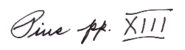
Pius, pp. XIII
August 12, 2002

Top of Page |
Pope's
Homepage |
 Email
Email
to Papal Secretary |
 |