

Caritas - Papal Office
by His Holiness Pope Pius XIII
April 12, 2002
HEAVEN or HELL -- Success or Failure
In ordinary school life the teachers conduct tests on their students to ascertain if their students are learning enough to be able to graduate when the year of studies is complete. A determined grade is set, and failure to make that grade spells failure. No teacher wants to give a failure mark, and no student wants to receive a failure mark. Hence both the teacher and student work together to succeed, for on it depends the quality of life for the future.In the spiritual life the quality of life in heaven or in hell is determined by our entire life here on earth. God’s test of each and every one of us at the moment of death will determine not only where we will go (heaven or hell) but exactly the quality of joy in heaven or the degree of misery in hell. All that is set up once and for all, and for all eternity.
We are directed along the way to heaven by God’s commandments made known to us by various means. God has placed a voice of conscience in each and every one of us, and in the final analysis our guilt or innocence will be determined on how we follow God’s commandments.
Those who die in the state of mortal sin go to hell. Those who die in sanctifying grace go to heaven. There is no way of avoiding this going to one of these two places.
We shall not dwell on the signs for those who go to hell. One goes there if he does not make it to heaven.
What are the marks of those who will go to heaven? Christ says, by their works you shall know them. Those who go to heaven perform the corporal and spiritual works of mercy to the best of their abilities.
The Spiritual Works of Mercy
- To convert the sinner;
- To instruct the ignorant;
- To counsel the doubtful;
- To comfort the sorrowful;
- To bear wrongs patiently;
- To forgive injuries;
- To pray for the living and the dead.
The Corporal Works of Mercy
- To feed the hungry;
- To give drink to the thirsty;
- To clothe the naked;
- To harbor the harborless;
- To visit the sick;
- To visit the imprisoned;
- To bury the dead.
It is rather difficult to personally visit those in prison. However, We suggest a method that is open to all of us. TAN Books and Publishers, Inc., P.O. Box 242, Rockford, Illinois, 61105 regularly gives books to prisoners, and contributing to that cause can increase that operation. If you know a prisoner and his address in jail you can send him Catholic books, according to his needs.
Feed the hungry need not just be giving a “lad of the road” a sandwich. There are hungry people in the USA and foreign lands, and We will gladly give addresses where to send help if We know you want those addresses. One can make this practical. Catholics have expensive pets to which they give feed, veterinarian service and the like. Here examine your conscience. Put down a record of the money you spend on a pet. Then, so to say, tell God I gave this to animals, and I neglected to feed you, my Lord, standing in the shoes of the poor. What one gives to the poor, and gets no material returns, is rewarded by God just as if it were given to Him. Letting oneself be carried away sentimentally over pets can carry one straight into hell. Some years ago a wealthy Catholic lady (always appearing to be poor) died with her will giving her entire large estate to pet shelters. It is hard to see how a person can throw God’s gifts to the dogs when God’s children must go hungry and naked, without committing mortal sin. Before God we are stewards of what God has given us. Before man our property belongs to us, but before God our property belongs to God, and he will judge us as a steward. Consider the parable of the unjust steward. He was punished for not doing his duty as the steward of his master’s property.
Every person should consider giving at death. It is a sin of prodigality to give ones property away before death when he needs it for ordinary living. However, one should protect his property from probate loss by putting his property into a LIVING TRUST. When that is done, the one you put in charge of your estate administers your estate according to the wording of your TRUST and your Last Will and Testament. The executor distributes your estate according to your will, and no lawyer and court action and fees are squandered. There is no reason at all to delay such action, and you become a benefactor of good causes that take place when you can no longer use your money or property. If you want advice in the matter of a LIVING TRUST We can advise you, and be assured it will mean a great reward for you when you die in the state of sanctifying grace. Not to have a LIVING TRUST and a will filled with charity is nothing less than squandering your Master’s goods. All of us are always just one heartbeat away from death, and death generally comes as a thief in the night. Once again, a word to the wise is sufficient. Be a just steward all the days of your life.
By Their Fruits You shall Know Them
Since 1976 when We first received Our first booklet entitled Novena to the Holy Ghost We have tried to put this booklet in the hands of every Catholic. In the front cover of that wonderful prayer booklet We printed the Fruits of the Holy Ghost. We give them here: Charity, Joy, Peace, Longaminity, Goodness, Benignity, Mildness, Faith, Modesty, Continency and Chastity.Before going into a consideration of the fruits of the Holy Ghost it is necessary to consider what preparation is required before such fruit can be expected. Our Lord gave the parable of the seed in order to bring home the difference between fruit-bearing seeds and non fruit-bearing seeds.
The seeds that fell by the wayside were consumed by the birds. Hence, no fruit was produced. Other seeds fell on thin soil, and they dried up, giving no fruit. Still other seeds fell among the thorns, and they were choked, so to say, by the cares of this world, and again they produces no fruits. Finally, the seeds that fell on good soil brought forth a plentiful harvest.
We shall take you through the steps in the spiritual life that make the seeds that grow have heavenly fruits.
At baptism God puts the supernatural life of sanctifying grace into the soul. Once that is present (simultaneously) God attaches to the soul the three theological virtues, namely, faith, hope and charity and the four moral virtues of prudence, justice, temperance and fortitude. These are operational powers similar to the software in a computer or farm machinery behind a tractor.
For those virtues or powers of action to operate well they must be perfected and assisted by the seven gifts of the Holy Ghost, namely, Wisdom, Understanding, Counsel, Fortitude, Knowledge, Piety and Fear of the Lord.
Sadly, one mortal sin deprives one of sanctifying grace, the virtues and the workings of the seven gifts of the Holy Ghost. Thus you see how very important it is to be always in the state of sanctifying grace, without which no one can go to heaven. Also, without it all the supernatural virtues and added powers are gone. In their absence the wonderful fruits of the Holy Ghost cannot be produced.
Briefly, wisdom, understanding and knowledge perfect and strengthen faith. Counsel perfects and strengthens prudence. Piety makes one more just. The fear of the Lord is most wonderful, for it replaces the cautious dictates of human reason by the exigencies of the good pleasure of our heavenly Father. The whole life of Christ and of His beloved Mother, Mary, was one of “fear of the Lord.” They not only did the commands and councils of the Father in heaven, but they also did what was His “good pleasure.” Christ was not commanded to submit to the painful death on the Cross, but the suffering of His passion and death was the good pleasure of His heavenly Father. Some of you may want to imitate Us in the following aspiration in Our morning prayers.
“O Holy Ghost give me an increase of faith, hope and charity: of prudence, justice, temperance and fortitude. Perfect and strengthen all of them with Thy Gifts of wisdom, understanding, counsel, fortitude, knowledge, piety and fear of the Lord. Finally, assist me in producing the Fruits of charity, joy, peace, patience, longaniminity, goodness, benignity, mildness, faith, modest, continency, and chastity. Turn all my difficult tasks into joyful works, thus turning all of them into Thy Fruits. Thus may I run with alacrity on the way to my heavenly home where I can enjoy the reward of a life well spent, doing always the things that are the good pleasure of my Heavenly Father, now and forever. Amen.”
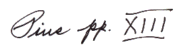
Pius, pp. XIII
April 12, 2002

Top of Page |
Pope's
Homepage |
 Email
Email
to Papal Secretary |
 |