

Terrorism & Revelation
It should be clear to one and all, unless they are blind and deaf, that the human race is moving into terrible times. Terrorism in the form of plane and bus hijacking, drive-by car shootings, baby snatching and so forth, all augur for terrible life experiences. When men refuse to be ruled by God, God will let them be ruled by tyrants. To put it in other words, God leaves God-less men stew in their own juice.Although it is revealed that no person knows when the end of the world will come, God makes many revelations concerning the end-times. The book in the Bible that combines very many of the revelations from the entire Bible concerning the end-times is the Apocalypse.
We bring to your attention the first chapter of the Apocalypse, verse three:
“Blessed is he that readeth and heareth the words of this prophecy: and keepeth those things which are written in it. For the time is at hand.”If one reads the Douay Rheims Bible he finds copious foot notes. We presume that most of Our readers have this Bible, still for sale from: TAN Books and Publishers, Inc., P.O.Box 424, Rockford, IL (USA) 61105, telephone 1-800-437-5876.
There is another wonderful Bible in the English language. It is the Douay-Rheims Bible by the Reverend George L. Haydock, in two volumes available from Catholic Treasures, P.O. Box 5034, Monrovia, CA (USA) 91017. Its great value is that it takes the whole Bible, practically verse by verse, and explains it by quoting chiefly from Fathers of the Church. This Bible is a most wonderful source of information and devotion. There are a number of books that explain the last book of the Bible. Here We give you the particulars for The Book of Destiny (Imprimatur dated January 28, 1956), by Fr. Herman Bernard F. Leonard Kramer. The book has 520 pages. Purchase it also from TAN. We have studied it, and noted it from cover to cover. We shall quote TAN Books to indicate for you just what to expect: “At last, a thorough, intelligible and truly great interpretation of the Apocalypse of St. John (Revelations – the last book of the Bible). Proceeds verse-by-verse and chapter-by-chapter: explains every-thing, omits nothing, all from a Catholic point of view.
While We have TAN Books before you, We shall add another book you may want to order. It has been out of print for many years. It is: A Catholic Dictionary by Donald Attwater, 1961 edition. Our edition received its imprimatur in 1930, and the new addition is the same, except disjointed from Pope Pius XII (in a separate list) there are the names of false popes John XXIII, Paul VI, John Paul I and John Paul II. Anyone can live with that, in order to have this wonderful book of general Catholic knowledge. For your convenience We give you the publisher’s observation on A Catholic Dictionary as follows:
“A goldmine of information with over 5,000 entries! Clear, brief, authoritative, easy to use. Facts, definitions, clear distinctions and the Church’s traditional teaching – without speculation, trendy opinions, compromise or dissent. Belongs in every Catholic home, school and parish! Best we have ever seen.” If you get it you will never want to be without it.It should be remembered that Christ told the people in Jerusalem to flee the city when bodings of the city’s destruction would appear. Those who had wisdom and caution fled the city when the Romans came to take it, and they saved their lives. Those who did not flee the city suffered a most cruel annihilation. God is not involved in an exercise of futility when He writes scripture, so it behooves the wise to read God’s revelation, understand it as it is given by the Church for their temporal welfare and eternal salvation. There is no vacuum as lamentable as a mind that lives in an ignorance it can reasonably dispel. Take to heart the words of God in the first chapter of the Apocalypse, verse three: “Blessed is he that readeth the words of this prophecy: and keepth those things which are written in it.”
Lest you may feel like passing up this admonition We shall stroke your conscience with God’s own solemn words, as found in II Timothy chapter three, verses 16 –17:
“All scripture, inspired by God, is profitable to teach, to reprove, to correct, to instruct in justice. That the man of God may be perfect, furnished in every good work.”A word to the wise is sufficient. Giving up all pride and self-will, bathe your mind and heart with the clean and fresh air of truth and goodness.
Study Helps
Whenever one reads valuable books, and that is all one really should read, it is highly recommendable that the reader have a piece of paper almost the size of the page in it as book marker. When one reads something of great worth he should write down the page and make a short remark to identify the important truth. That should be done for the entire book, and if the sheet is filled before the end, another sheet can be pressed into service. Never remove those notes, for years later you may want to refer to those valuable notes. Never write in a book, for one who loves his neighbor wants his books to serve those who follow him. It is extremely selfish to mark up books, thus making them quite useless to others. Such aberrant conduct also makes it impossible to make clean copies (when no law is infringed) of books or just pages at any future date.It could be that We learned something late in the field of making notes. You may know that there are yellow Post-It Notes. There is also a Scotch Tape product which has the word on the box REMOVABLE. The roll is no different from other tapes, so it can be used in any dispenser. The ad says, “You can lift it off for changes,” and “Lifts off clean, Never tears paper.” You would not use that tape to seal an envelop, but it can be used where you want to put a marker in a page, where you want to stick a note on a shelf or wall, and later remove it. As a learning tool this is a God-sent blessing. Its numerous uses are limited only to the extent of your own inventive imagination. It is a wonderful tool for mundane and spiritual learning for man’s eternal salvation. For that We say: Deo gratias.
Ask God For His Help in Asking For His Help
When the priest starts his Divine Office (his daily obligatory prayer) he does so as follows:| V: | Domine, labia mea aperies. | Lord, open my lips. |
| R: | Et os meum annuntiabit laudem tuam. | And my mouth will announce your praises. |
| V: | Deus, in adjutorium meum intende. | God, come to my assistance. |
| R: | Domine, ad aduvandum me festina. | Lord, quickly come to my assistance. |
To avoid confusion of words, the Church keeps three terms of worship in the Latin language. Latria means the honor (adoration) that is given to God alone. Hyperdulia means the honor that is given to the Blessed Virgin Mary alone, and to no other. Dulia is the honor given to all the Angels and the Saints. Mary has a form of honor, all for herself, because she far exceeds the greatness of the Angels and the Saints. This explains why Mary has a very special place of honor among the Saints. She receives not Latria nor Dulia but Hyperdulia.
We opened this tracts telling you to ask God’s help, even in your prayers for help. Not all prayers have the same value before God. Every salutary act (that is, every act worthy of forgiveness and/or advancement in grace and merit) must be preceded by, accompanied with and followed by the light and strength of actual grace.
One spiritual writer put it this way. When praying, think of yourself as writing with an old time fountain pen. If you have fluid gold as you ink you will write in gold. If you have black ink in the pen-barrel you will write in black. If you have water in the pen-barrel you will leave no tracks on the paper. We do not want to send a blank sheet to God, for “blank” will be the results. We want to write our prayers to God with golden letters of true devotion, to get His attention and will to help us. Hence, we must do all we can to pray well. In order to pray well, we must ask God for the help to do so. Take for yourselves the words that the Church commands the priests to say before praying his Breviary. Before praying you will do well to use the words in italics above.
The holier, the more saintly, one becomes, the more refined he becomes in all things. His appearances are refined (not dressed by design as a rag peddler and with unkempt hair). His words are Christ-like, from a Christ-like heart. His prayers, as far as is possible to him, are said with dignity, attention and devotion.
In Philippians 2, 9-10 it is written:
“For which cause, God also has exalted him and hath given him a name which is above all names; That in the name of Jesus every knee should bow, of those that are in heaven, on earth, and under the earth.”In the Divine Praises, used at Benediction of the Blessed Sacrament, one invocation is: “Blessed be God in his Angels and in His Saints.” As devotion prompts you try to distinguish by the bow of your head, the difference between latria, hyperdulia and dulia. Make the bow to God deeper than that to the Blessed Virgin and the Saints. Make the bow to the Blessed Virgin, Mary, less deep than that to God and deeper than that given to the other Saints. Thus, the refined and devout person at least tries to observe that delicate protocol, intimated by Us (possibly the first time), and by the simple logic of prayer, to different objects. The priest observes this protocol in Mass as directed.
The Working of the Gifts
Where ignorance follows rote memory in catechism, the divine virtues and the gifts of the Holy Ghost get thrown together as so many blocks in a wall. Not so in reality! By way of review, the theological virtues are faith, hope and charity. The moral virtues are prudence, justice, temperance and fortitude. The gifts of the Holy Ghost are wisdom, understanding, counsel, fortitude, knowledge, piety and fear of the Lord.From Father Edward Leen’s book: “Grace and the Supernatural,” with the imprimatur dated 1937, We quote from pages 85-6 as follows:
“It is clear from all this that the function of the gifts is to strengthen and perfect the operations of the virtues. Wisdom, Understanding and Knowledge come to the aid of Faith. Counsel takes away the hesitations of Prudence; Piety gives a loftier aim to Justice; Fear replaces the cautious dictates of human reason by the exigencies of the good pleasure of our heavenly Father, and Fortitude reinforces the virtue of the same designation.”For some, the above quotation may be clear, and yet for others an explanation is required. The word “virtue” comes from the Latin word for man, “vir.” It denotes strength (the physically stronger of the sexes). At baptism the virtues (all of them) are implanted into the soul of man. Through mortal sin man loses them in a certain order, which is another study. Consider your soul with sanctifying grace and the divine virtues as listed above. For you to act as a Christian should act, you must act with those powers in you. Without doing that you become like those outside the banquet hall, where there is weeping and gnashing of teeth. Today it is lamentable to see so many of our Catholics with live-in partners and those divorced. Do they not know that such a mortally sinful life is the sure way to hell? Fifty years ago Pius XII, of happy memory, observed that men have now lost the sense of sin. Today We add to the words of Pius XII our conclusion, that “many have lost all sense of sin and shame.”
An example of Piety giving a loftier aim to Justice is found in Luke 19, 8:
“Zacheus standing, said to the Lord: Behold, Lord, the half of my goods I give to the poor, and if I have wronged any man of anything, I restore him fourfold.”Justice without Piety would restore only what he owed.
Examples of Fear replacing the cautious dictates of human reason by the exigencies (here and now demands) of the good pleasure of our heavenly Father would be: Abraham’s obedience in commencing to sacrifice his son. Also, Christ threw away human caution when He notably brought on His own crucifixion by driving the money-changers out of the Temple, in order to follow the exigencies of His heavenly Father.
By way of example we shall lead you through a few aspirations. “Oh, Holy Ghost, perfect and strengthen my virtue of prudence with Thy gifts of Wisdom and Counsel.” Also, “Oh, Holy Ghost perfect and strengthen my virtue of fortitude with Thy gifts of Wisdom and Fortitude.” Continue on and on as the Holy Ghost leads you.
The Indwelling of the Holy Ghost
Two phrases work together in explaining the great dignity of the sanctified. Those phrases are indwelling of the Holy Ghost and temple of God.We can come to some appreciation of the great dignity of those sanctified as Christians by considering the words of St. Paul to the Corinthians (I Cor. 3, 16-17):
“Know you not that you are the temple of God and that the Spirit of God dwelleth in you? But if any man violate the temple of God, him shall God destroy. For the temple of God is holy, which you are.”God dwells in the sanctified soul as seen in John 14, 23:
“If anyone loves me, he will keep my word. And my Father will love him, and we will come to him and will make our abode with him.”Groveling to explain this “indwelling in the soul” Father Joseph McSorley in his book called Meditations for Everyman (p.3) says the following.
“When we speak of God we use human words. When we picture Him we make images derived from matter. Yet we know perfectly well that words and images are hopelessly inadequate to represent God. It is not surprising, therefore, if our first attempts to imagine the presence of the Holy Ghost in the soul are childishly insufficient –however sincere, however truly inspired by affection, however firmly based on sound teaching. God cannot be in the soul as water is in a container, or as a man in a house, or even as the Body of Christ is in the tabernacle. We shall get a more helpful notion of a spirit (although still inexact), if we liken it not to objects, but to forces – heat, gravity, electricity, magnet-ism, all of which are invisible, powerful, and not easily or crudely confined.The perfecting of the understanding of this mystery is secondary to the perfecting of the appreciation and love of this mystery. Dying with this mystery functioning in the soul, brings one to heaven. If this transformed soul is destroyed by even one mortal sin (and remains so without forgiveness) it is sentenced to everlasting damnation at the moment of death.“When we affirm that a spirit is present anywhere, we mean it is active there. The manner and the degree of presence vary with the manner and degree of activity. Thus, for example, the Creator is present in man when He gives man existence, and again when He gives him intelligence; He is present in still another way when he infuses supernatural light into the soul. The coming of the Holy Ghost means that God become active in the faithful disciple as never before. He comes more completely and more perfectly, enriching men with new and greater gifts.
“Thus thinking, I turn my eyes within, and I say: “Dear Lord, You have been in this place and I knew it not.” But now at last I recognize and I adore You. Honor and glory be unto You. Oh hidden God within my soul. Forsake me never! May You be blessed and praised by every creature! Most of all, may You always be blessed and honored and served by me!” [end quote]
The Blessed Virgin Mary
Spiritual writers list several signs by which a person can judge whether he is likely to be saved, that is, go to heaven. Those same writers also list the signs that show the great danger of being damned. All agree on one sign for both eventualities, and that is the Blessed Virgin Mary.Those who have a proper devotion to Mary have a good reason to believe that they will go to heaven. On the contrary, those who have no proper devotion to Mary have every reason to fear that they will be damned.
Those who need Mary’s assistance the most are those who generally do not have that devotion. We shall tell you a true event to make this point clear.
A Catholic lady visited her Protestant neighbor lady, and during the visit she noticed a picture of the Blessed Virgin on the wall of house of that Protestant lady. The Catholic lady exclaimed: “Oh, I always thought that you Protestants did not honor the Blessed Virgin, Mary, and here you have her picture on your wall.” The Protestant lady took a good look at the picture and said: “Oh my, I never knew that it was a picture of Mary. I thought that it was a picture of an angel. You can have it.” And the Catholic lady went home with another beautiful picture of the Blessed Virgin to decorate another wall in her Catholic home.
Obviously, devotion is both internal and external, and the external is quite useless unless it is united with ones internal prayer-life. Especially in these troubled times, every Catholic should be saying the Rosary daily. They should also be wearing the Brown Scapular. Every worthwhile life is developed around firm habits or good methods of doing ones duties to God, himself and his fellowmen. A hit and miss life in the natural and supernatural order is doomed to miserable failure. Consider God saying (Apocalypse 3, 16) to a soul long before death:
“But because thou art lukewarm and neither cold not hot, I will begin to vomit thee out of my mouth.”With God’s help be a winner and not a loser for all eternity.
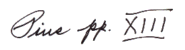
Pius, pp. XIII
January 15, 2002

Top of Page |
Pope's
Homepage |
 Email
Email
to Papal Secretary |
 |