

Authority from God
While addressing Jesus:“Pilate therefore saith to Him: Speakest thou not to me? Knowest thou not that I have power to crucify thee, and I have power to release thee? Jesus answered: Thou shouldst not have any power against me, unless it were given three from above.” (John 19, 10-11).Consider also the words found in the first and second verses of the thirteenth chapter of Romans:
“Let every soul be subject to higher powers. For there is no power but from God. Therefore, he that resisteth the power resisteth the ordinance of God. And they that resist purchase to themselves damnation.”No one has any authority ecclesiastical or civil over another human being unless he receives it from God. Therefore, anyone who claims authority over others must prove that he has a legitimate title to his position. While it true that there are times when it is difficult to prove that one holds a position which has divine authority, that fact of a title to divine authority, nevertheless, always remains true.
In the fourteenth century a dispute as to who had authority in the Church continued for nearly forty years before it was settled by a valid election of the Pope.
Throughout the world, in the civil arena, governments come and go, and change on a continuing basis. In the civil arena the citizens are free to set up any government that suits their wishes and serve their needs, provided they are subject to God through being subject (rightly understood) to His Church. Every individual and every government on earth is bound to be subject to Christ the King.
Again while addressing Jesus:
“Pilate therefore said to him: Art thou a king then? Jesus answered: Thou sayest that I am a king. For this was I born, and for this came I into the world: that I should give testimony to the truth. Every one that is of the truth heareth my voice.” (John 18, 37).For the peace and prosperity of nations and for the eternal salvation of every individual person, God demands subjection to Christ the King on this earth so that in heaven they may be subject to His reign forever. Any society that is still not subject to God in Christ (in His Church) is reminded that it is their duty to do so as quickly as possible and remain in that subjection to the end of life. Refusal to do so will bring God’s sanctions (punishments) in this world for states, and in the next world, sanctions for individuals forever in a place called hell.
It is just possible that some readers may say that they would like to see the program for the Christian state, as God demands it. It is fortunate that We can offer you a book that deals with this very topic, a lengthy book of 700 pages, entitled “The Framework of a Christian State” by Father E. Cahill, S.J. The imprimatur is dated 1932. It has just been re-published by Roman Catholic Books, P. O. Box 2286-2286, Fort Collins, CO 80522. The price is $49.95 in hard cover (only): with special rates for schools. For the first book the p/h is $2.95 and then 90 cents for each additional book. You can phone them at (970) 490-2735.
Among many other items of interest the catalog ad reads: “Father Cahill approaches his daunting subject with old-fashioned Jesuit thoroughness … subheadings on every page, marks each topic. Footnotes point you to hundreds of Church documents, primary sources and important references. A detailed table of contents and 25-page index guides you to sound Catholic answers to more than 2000 specific questions.
This simple to read and yet scholarly book has God’s teachings, through His Church, in regard to the proper way states are to be formed and run. The Church is the leaven that makes this world a proper place to live, and work out our eternal salvation. This formula for right government should be in the hands of all men and women who can have an influence on the government. This book should not be left under the bushel, but it should, by all means, be placed on the lamp-stand to shed divine light on the way to heaven.
We come back to Christ before Pontius Pilate. God places His authority in men, and authority is divine. In the state, citizens establish how authority is given, as for example: by elections, appointments and the like. Every one who exercises authority must be able to show the source of his authority. A man may (as sometimes happens) impersonate a law officer. He has no authority from his homemade badge. His authority must come from the government. He is deputized into his office. God has ordained that there be two lines of authority in this world. One is ecclesiastical authority, and the other is civil authority. They are basically independent of each other, and at the same time they must work together.
The basic unit in the state is the family, without divorce and remarriage. Today, one-parent families are an aberration, and with those liberal ideals for the construction of the state, it is no wonder that things are going awry.
The question comes up, just how are civil wars and international wars to be avoided? The Church has a solution for that problem also. By a singular work of divine providence We purchased from a used book agency a book entitled: “National Patriotism in Papal Teaching.” The imprimatur is dated 1942, and the author is Father John J. Wright. The publisher is The Newman Bookshop, Westminster, MD (Maryland, USA) 1943. Father John Wright wrote this while he was a priest in Boston, MA. Later he became an auxiliary Bishop and subsequently a Cardinal, during and after bogus Council Vatican II. We are sorry about the way his life ended in the Novus Ordo Church.
This book has a singularly high approval. Here is what is in the front of the book: Vidimus et appropbamus (We saw it and we approve of it) Rome, ex Pontificia Universitate Gregoriana die 21 mensis julii anni MCMXXXIX (1939) The officers of the Pontifical University, the Gregoriana saw (studied) the book and gave it their approval. Marvelous!
The book has 358 pages of fine print. It does not have a library of congress number, and We have the one and only copy that We know of. We shall try to get some book publisher to re-publish it. If any reader knows a way to get this book re-published We would be pleased for any such information.
The book deals with the very problem that is going on in Israel today. On pages 310-312 it says: “We shall, however, at least state the practical directives which the Popes have provided the nations on how these may discharge the obligations incumbent upon them to subordinate the claims of their nationalism to the needs of the human community and may promote the organization of the latter required by the manifest nature of society. These directives may be expressed in a threefold program: arbitration, security, and disarmament of the nations within the framework of a “much to be desired” league, or rather a sort of family of peoples, calculated both to maintain the due independence of nations and yet to safeguard the order of the unit human society.” By the way, there is a worldwide organization already to care for worldwide mail service.
We shall analyze the above. Our predecessors visualized some kind of international “league” in which all the nations of the world cooperate in settling disputes between nations. Unlike the UN which “incites” violence and then sends in “peace-keeping” forces, it would be a sensible forum in which the three points above are applied.
Arbitration…. This means that in a no-end dispute the countries involved agree to live by the decision of some agreed upon arbitrator. They accept that person’s decision, say, in a border dispute.
Security…. This means that the countries of the world exert boycott penalties against a country or countries making unreasonable demands. That should bring the offending nation or nations to act sensibly.
Disarmament…. This means that all the countries of the world work on keeping armaments to a minimum, for when countries are highly armed they cause a hardship on their citizens to maintain them, and the readiness to settle disputes with war becomes the ready-way solution to any nasty problem.
Coming back to Israel today: no matter where a line is drawn in the sand, one of the opposing countries always objects to the solution. The danger of a terrible world war looms higher as the days go by. We have no forum to bring this solution even to the attention of the world. The human family must find ways and means to live in peace and harmony. What all the readers can do in this exercise of natural law (which is common sense), is to pray to God to move the warring parties towards rightful actions, in the order of justice and charity.
Authority From God in His Church
Christ has determined for all time the form of government for His Church. He established in Peter and in his successors the primacy of jurisdiction over the whole Church, that is, over every group in the Church and over each individual Catholic.How does God give His ecclesiastical authority to the Pope? From the time of Peter, the Popes have been brought into power by a valid election of Catholic voters. Under Pope Pius XII (died October 9, 1958) there were Catholic Cardinals in whose hands rested the election of the Pope. By a peculiar series of unfortunate events those valid electors elected a man, John XXIII as Pope. We shall not labor the points where he either never received the office of Pope, or he lost it by reason of canon 188 #4. We shall show with clear arguments that his successor certainly departed from any possible office of the papacy by reason of his professing that he worshiped man (making him a heretic). Man was Paul VI’s god. Canon 188 #4 says that a cleric who defects from the faith (externally expressed) is ipso facto out of his office, and there is another point to this law, “he must make for himself a new religion or join an old false religion.” The Novus Ordo is a new religion with
- a bogus Council (teaching the heresy that one religion is as good as another and where it is a civil right to chose any religion,
- a new liturgy with invalid sacraments,
- a new Canon Law to guarantee and give credence to the new religion in law, and
- a new “Catechism of the Catholic Church” to propagate the new religion.
Two elements are involved in recognizing the Pope. One is the valid election of and by Catholics when the See of Peter is vacant. The second point is the viewing of that election with the gift of divine faith.
Our Lord proved beyond doubt by means of His many miracles that He was the promised Redeemer. Why He was not universally recognized as the Redeemer was the fault of those who saw His miracles. They viewed the miracles without the gift of faith, and without the gift of faith nothing in the supernatural order can be seen. That problem will continue to the end of time. Many of the now fallen-away Catholics, must remember that when Pope Pius XII was elected Pope, none of the Russian and Greek Orthodox nor the Protestant world recognized him as Pope. Only those with divine faith recognized Eugenio Pacelli as the Pope, because of his being elected by the body of Cardinals. Once again, on October 24, 1998, there was a papal election, and only those with divine faith recognized Us and still recognize Us as the Pope.
This phenomenon of belief and unbelief can be found in the Gospel of St. Luke 2, 34:
“And Simeon blessed them and said to Mary his mother: Behold this child is sent for the fall and for the resurrection of many in Israel and for a sign which shall be contradicted.”If Simeon were present at every papal election, he would point to the new Vicar of Christ and say: “Behold this (Pope) is sent for the fall and for the resurrection of many in (the entire world) and for a sign which shall be contradicted.” Our Lord told the Apostles (John 16, 3):
“And these things will they do to you because they have not known the Father nor me.”We have advanced to the point where We must prove that God has placed Us over His flock. As stated above, We were elected in a papal election by only Catholics, with the electorate consisting of all the Catholics who consented to be in the election process. Viewing that election and Our consent, We see with divine faith Ourselves as the Roman Pontiff, the Vicar of Christ. The papacy is no more felt in the individual who possesses it than does a bishop or priest feel his Holy Orders. Only by divine faith is it known to the individual himself and by those around him. Take two people, one with the faith and one without the faith, who both observe the Bishop impose hands on a man at ordination. The believer will see the priesthood in that ordained man, while the unbeliever will only see one man putting hands on the head of another man with no results.
By God’s ordinances in founding His Church, Christ (the God-Man) established that every Catholic must be subject to the Pope. The order (or chain) of command is: Pope to Bishop (Ordinary), Bishop to priest (Pastor) and priest to parishioners. This presumes there is a living Pope. In interim between the death of the Pope and the election of his successor, the reign of the last Pope continues.
We need not labor the point that the Orthodox and Protestants do not want to be Catholics. A single ruler over the whole Church is denied by them. During the forty years interim between the death of Pope Pius XII and the election of Pope Pius XIII even the sincere Catholics who parted from the Novus Ordo developed a schismatic mentality of Catholicism, being without a Pope, some even rejecting the idea of any authority at all over them. They forgot or ignored the four marks of the Church enumerated in the Creed of the Mass: one, holy, catholic and apostolic. Apostolic means more than just from the apostles, it means being ruled by the successor of Peter.
Go around to “Catholic enclaves” such as the Society of St. Pius X where they have a superior. He has no real subjection to any Pope (while proclaiming that John Paul II is the Pope). The Bishop Thuc enclaves have no central ruler, and they have independent priests and “bishops” without any superior over them. There are numerous freelance priests calling themselves Catholic and fooling the gullible public to believe that they are Catholic. They have lost the four marks of the Church, and the marks that all of them have, are only two: the good old Latin Mass and holding to tradition (except the tradition that the Pope must rule them in order to be Catholics). Just observe their universal conduct. We know a family in Montana, USA, that goes to any and all services where the Latin Mass is said, where no questions are asked by the priest. The priests show among themselves the same marks. Just go to the funeral of a traditional freelance priest. You see other freelance priests of all confessions assisting at the Solemn High Mass – priest, deacon, subdeacon and so forth. They are all one, and yet they have no unity by reason of being subject to one and the same Pope. Is it not clear that the mark of ONE, clearly is missing from those enclaves and associations? When they say the Creed in the Mass they profess that they believe in the “one, holy, catholic and apostolic Church,” but it means no more to them than if it were said by a heathen or a publican.
A Thuc Bishop is the superior of the enclave on Mt. St. Michael in Spokane, WA., plus some scattered priests around the country. That Bishop has no authority from God until he gets it from the Pope. There is no way on earth that he can get ecclesiastical authority over any subjects except he gets that authority from the Pope. No man can give himself either ecclesiastical or civil authority over people without getting the authority from God in a divinely established order. The Bishop over Mt. St. Michael and the superior over the Society of St. Pius X and others can no more make themselves religious superiors with divine authority, by themselves alone, than can a charlatan make himself an officer of the law. They must get authority from whatever source can give that authority, the way God gives it, or be without it forever. Just as a man who impersonates a law officer is a criminal, so to a man who impersonates himself as a religious superior or freelance priest is a criminal. The just God will grab him when he dies and haul him to the prison where there is weeping and gnashing of teeth forever.
To all those who know of Our taking the papal office through a papal election as explained above, We urge them to pray for the gift of divine faith. In Hebrews 11, 6 it is revealed that:
“…without faith it is impossible to please God. For he that cometh to God must believe that he is: and is a rewarder to them that seek him.”The necessity of acting on the above information is seen in the dogmatic proclamation of Our predecessor Boniface VIII as he put it in the conclusion of his Bulla called Unam Sanctam (dated November 18, 1302), Denzinger #469: “Furthermore, we declare, say, define, and proclaim to every human creature that they by necessity for salvation are entirely subject to the Roman Pontiff.”
Do Penance
When We had only a Protestant Concordance to reference the Bible, We failed to find the world penance. The Catholic Concordance now available, displays penance thirteen times in the New Testament alone. Hence, the saving doctrine from Christ of penance is removed in concept and act from Protestantism.Here is an example from the King James Bible (a heretical Bible):
“I tell you, Nay: but, except ye repent, ye shall all likewise perish.”The Catholic (Douay Rheims) Bible says:
“No, I say to you: but unless you shall do penance, you shall all likewise perish.”Both are from Luke, 13, 3. There is a great difference between repent and do penance.
Repent merely means that one must be sorry for one’s sins and faults. When turning to God, that is the first step on the way to salvation. However, it is in no way enough to only repent in order to get to heaven.
With the Holy Season of Lent about to start, We must exhort all Catholics to take seriously Christ’s command to do penance. In broad outline, penance means: prayer, fasting and almsgiving.
Prayer means the lifting up of our minds and hearts to God in adoration, thanksgiving, expiation (which means repentance) and petition. Pray the Holy Rosary, the Novena to the Holy Ghost, litanies, Stations of the Cross and so forth and so on.
Fasting means the giving up of all unlawful acts (sins) and some lawful acts also for reparation for sins committed and for personal training to remain free from the temptations to sin.
Almsgiving means contributing from our God-given strength (goods and
services) to help the poor, for the love of God, because they represent
to us, God Himself, who will reward us for this service as if it were done
to Himself. Goods and services are enumerated in the Catechism as
Spiritual and Corporal Works of Mercy. To enumerate a few they are:
feed the hungry, visit the sick, bury the dead, counsel the doubtful, instruct
the ignorant, pray for the living and the dead and so forth.
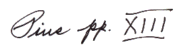
Pius, pp. XIII
Feb. 12, 2001

Top of Page |
Pope's
Homepage |
 Email
Email
to Papal Secretary |
 |