

Psychological Seduction
Psychological Seduction
from: The Failure of Modern PsychologyWhen men decided that they would get their moral code and social order not from God but from man, they turned away from God’s Church and put psychologists in charge. Today the world is living in the confusion and the evil that was handed to them by god-less and man-worshiping idiots, called psychologists.
by William K. Kilpatrick, purchase from
ROMAN CATHOLIC BOOKS
P.O. Box 2286, Fort Collins, CO 80522-2286 @ $19.95 p/h $2.95
Where the Catholic Church held sway, the moral order for individuals and social order for society as a whole, became ever more godly. Once subjection to God in His Church was overthrown by the Eastern Orthodox, the Protestants and the like, there was a steady decline in morality and a steady destruction of the Christian Social Order. In fact, the enemies of God, largely lead by the Freemasons, concocted a planned conspiracy to overthrow both private morality and the entire Christian Social Order. They engineered the French Revolution, killing not only the bishops, priests, and religious; but also the Kings of Europe.
Once the Freemasons gained control, the education of the youth fell into their hands. They devised the state school or public school system, in which God was excluded. We see the result today. Teachers and children are being murdered on a regular basis. Even basic learning is being destroyed. It became so bad that even some graduates from High School were unable to read their diplomas. The mere “methods of teaching” reading and mathematics made learning very difficult.
With the above destruction before society, the psychologists were brought in to tend to the problem. It amounted to no more than putting the fox in charge of the hen-house. Psychologists were given the task to finish the job of destruction. When the chemicals from the fireman’s hose makes the fire bigger, you know on whose side he works.
In this short treatise We can no more than scratch the surface of the problem. Psychologists came on the scene as “priests” of a new naturalistic religion. They not only ignored what was Catholic in society, but they replaced the Church with their religion of pure naturalism. All at once, the human race could “live up the evils of sin” without a challenge. The Catholic Church had held the line, and put down the evil inclinations of man. Those who cooperated with grace were able to live more or less free from the slavery of sin. Living in the service of God is true freedom.
The influence of psychology covered the whole spectrum of life. Violation of God’s Ten Commandments became the order of the day. A crisis of faith struck the world. The younger generation became completely peer orientated. Tradition has no value for such youth. Reality and the moral order were matters of their own creation. Much of this was done through discussion sessions. God was left out of the equation.
When there was a problem: two, three or four persons gathered together for a discussion, and the conclusion had to be accepted as a reality or the moral order as the case required. Our Lord gave order to men by having them directed in reality by the infallible teachings of the Church. For the new psychological society, all the Church’s work was relegated to a trash bin of irrelevancy.
The face of society changed. The lowest type of cloth, denim, became what the youth and some adults called “cool.” You saw washed out and tattered denim jeans on boys and girls everywhere-- in Church, at weddings, in the air ports, and even at high class festivities. The very idea of having a dress suit of clothing was lost to the point that young people never even owned a Sunday suit. The very concept of celebration and fun was lost. Each one (unknown to himself) under peer pressure did his own thing. The works of penance, so necessary for right living, were abandoned. Not only was preaching on hell frowned on by religious superiors, but it was forbidden – once and for all. Not having caught on quickly enough to the abandoned teaching of hell in sermons, We experienced, first hand, the anger of Our superior. He made it clear that Our preaching on the topic of hell could not be continued.
It is worth our while to consider a case that was observed by Us, and recorded by the author of this study, William K. Kilpatrick. On pages 176 and l77 he writes:
“The classic example of this misguided desire for relevance occurred in 1967 in Los Angeles when a large Catholic school system staffed by nuns invited Carl Rogers and his colleagues from the Western Behavioral Science Institute to carry on an experiment in “educational innovation” within their system. What ensued was an intense program of encounter groups lasting more than two years. It started off as one of those well-intentioned efforts we discussed in an earlier chapter, but the effect was not unlike the effect of inviting the devil into the convent of Loudon. At the beginning of the project there were six hundred nuns and fifty-nine schools: a college, eight high schools and fifty elementary schools. A year following the project’s completion, according to William Coulson, one of the project leaders, “there were two schools and no nuns.” The nuns had cut their ties with the Catholic Church and had set themselves up as a secular order. From there, many drifted out of the religious life altogether.Sit down and weep with Christ over the fall that has occurred (a repeat of history) in our own times. Those of you who want to put your finger on all the specific problems of this fall should purchase the book advertised in the title of this newsletter. The author, being a generic Christian, leads you to the door of the solution, but he does not go through the door--namely, to the Catholic Church.Although the events leading up to the secession were complicated by several factors, including the conservative nature of the Los Angeles archdiocese and a rising tide of feminism within some Catholic Orders there can be little doubt that Roger’s influence was a decisive, if not the decisive, element. Coulson, who seems to have mixed feelings about the outcome, gives the credit (or blame) to Roger’s group. “We did some job,” he observed. Having read transcripts of parts of the encounter sessions, my own impression is that Rogers had effected something like a conversion. Many of the nuns confessed they had never felt so spiritually alive. Since I had been more or less converted to the faith of humanistic psychology merely by reading Rogers, I can well imagine the impact that two years of personal contact must have had.”
Parents, who see their children sinful and worldly, have no solution outside the Catholic Church. As long as children live under the accepted guidance of psychologists, they will never become firm Catholics. Furthermore, they will not become candidates for the glorious call of God to the priesthood and the religious life. It is a singular joy for Us when We see just a few young people express their belief that they have a call from God to the priesthood and/or religious life. By the movement of grace, they take steps to accomplish that which they believe is their divine calling. They are different from their God-less peers, and it is likely that they will be different from them in the next world also.
“I believe…in the forgiveness of sins….”
The very first step in the forgiveness of sins is the theological virtue of faith. When St. Peter, in his second Epistle, (II Peter 1, 1) addressed the faithful (those having faith), he said the following: “Simon Peter, servant and apostle of Jesus Christ: to them that obtained equal faith with us in the justice of our God and Savior Jesus Christ.” Our first step is to make clear just who are those who are numbered with those who have obtained equal faith with St. Peter and his successors.Who are excluded from those with the faith? They are those who are separated from God’s Church by heresy, schism and apostasy. Heresy separates one from the Church by a violation of the virtue of faith. Schism separates one from the Church by a violation of the virtue of charity. Apostasy means a total break with the Church, so that practically nothing is believed. Original sin also makes one to be without the virtue of faith. While persons are in the above states, there is no forgiveness of sins. Outside the Church there is no salvation.
There are two (not completely disunited) groups of people with the gift of faith. They are the members of the Church, which means: one has a valid baptism of water, one believes (with divine faith) everything that God teaches through His Church, and finally, he is subject to the Roman Pontiff. The second group with the faith are those within the Church by, what is called, the baptism of desire (or Church by desire). Since only God can read the hearts of man, nobody knows just who they are that are within the Church, but without membership.
Lest some traditionalists make the fatal mistake of believing that they are within the Church, We shall explain one important element in being within the Church by desire. When the truths of the Church are sufficiently presented to them, they must, in order to be saved, join the Church by becoming members of the Church with the above three qualities.
There are two desires. One is efficacious, and another is inefficacious. Let us make this hurtle with a parable. Two men desire to go to Australia. The man with an inefficacious desire just lets it go with merely desiring. He does nothing about the trip. The person with the efficacious desire does many things. He contacts a friend in Australia. He buys a ticket. He gets a visa. He sets things in order at home. He pack his bags, and so forth. There you have the distinction between efficacious and inefficacious desires.
A person who ignores the facts of the Church before him, cannot say that he is honest, and that he deserves grace. By some means, not known to man, God opens the road to heaven to every human being; for He revealed in the Gospel of St. John the following: (John 1, 9) “That light (Christ) was the true light, which enlighteneth every man that cometh into this world." Hence, no person can ever say that the facts of God and His Church were withheld from him. All he will be able to tell Christ, his just judge, on judgment day, is that he did not study (efficaciously) that which was given to him for his eternal salvation.
With the above qualifications in mind, We move on to what is necessary for forgiveness. We deal with this teaching so much because nearly all of the Catholics in the world today are without the personal services of a priest, who is subject to the Roman Pontiff, Pius XIII. There are two acts of contrition that effect forgiveness of sins; they are:
Attrition & Contrition
Imperfect Contrition & Perfect Contrition
Old textbooks used attrition and contrition before the terms imperfect
contrition and perfect contrition came into use. We will confine
Ourselves to the generally used terms of imperfect contrition and perfect
contrition for this explanation.
Imperfect contrition obtains forgiveness of mortal sin, only when united with a proper sacrament. Imperfect contrition, together with the baptism of water, removes mortal sins. Imperfect contrition, with the sacrament of penance, removes mortal sins. When confession is not possible (e. g., the person is unconscious) Extreme Unction removes mortal sins.
Perfect contrition (for those within the Church) removes mortal sin, even without the baptism of water (while it is desired efficaciously). Perfect contrition removes mortal sin without confession (while it is desired efficaciously - I will go to confession when I can).
Imperfect contrition and perfect contrition are identical, except for one apparently small, but most important, element. It centers on how one views and approaches God.
Perfect contrition is accomplished only when one is sorry because he offended God, Who is “all good” in Himself. If one is sorry because God is “all good” as the Creator, Redeemer, Sanctifyer and Benefactor, the contrition is imperfect contrition, and it removes mortal sin only with the assistance of the proper sacraments, as mentioned above. Over the years We have used the best available traditional acts of contrition in the books, and all of them neglect to add the bold print two words “all good in Thyself.” Whether one expresses it or not, that is how one must view God and approach Him for forgiveness on the spot. We urge one and all to either use the contrition formula that We made, or use the old formula with the all important element added-- not merely in your mind, but also by words themselves, namely, in Thyself.
A traditional form:
“O my God, I am heartily sorry for having offended Thee, and I detest all my sins, because I dread the loss of heaven and the pains of hell, but most of all because they offend Thee, my God, Who art all-good (add: in Thyself) and deserving of all my love. I firmly resolve, with the help of Thy grace to confess my sins, to do penance and to amend my life. Amen.”Our more developed form is:
“O my God I am heartily sorry for having offended Thee, and I detest all my sins, known and unknown, not only because I dread the loss of heaven and dread the pains of hell, and not only because Thou art my Creator, my Redeemer and my Sanctifier, but most of all because my sins have offended Thee, my God, Who art all good in Thyself and deserving of all my love. I firmly resolve, with the help of Thy grace, to confess my sins, to do penance and to amend my life. Amen.”
Beware of becoming LUKEWARM
In the absence of a parish and a priest, the following platitude may swing into action: “Out of sight, out of mind!” To show you how God detests those who are lukewarm, We quote from the Apocalypse (3, 15-6): “I know thy works, that thou art neither cold nor hot. I would thou wert cold or hot. But because thou art lukewarm, and neither cold nor hot, I will begin to vomit thee out of my mouth.”The first thing to examine one’s conscience on, should be: “Just how do I observe Sundays and Holy Days of Obligation?” One should make it a day of celebration, wearing Sunday clothes and eating in a festive fashion. One should pray from some book, such as (a new source) Goffine’s “The Church Year,” at $24.95 p/h $1.00 + 10% from MMR Publishing, P.O. Box 45348, Omaha, NE 68145-0348. Nebraska Res. Add 5% Sales Tax.
United with former popes, We stress the need to study the catechism, which is the study of the Catholic faith.
Sundays are to be made ever more holy by prayers (united with the Mass of the Sunday – a Goffine assist). Learn to use and love traditional Litanies, Stations of the Cross, and the like. Have on hand wonderful books for spiritual reading. The gift of wisdom will make you relish this kind of reading. A profound study of the catechism is in “The Catechism Explained” by Spirago-Clark at (800) 437-5876, TAN Books & Publishers for $37.50 +p/h $5.00.
Sundays should also be times for the performance of the Spiritual and Corporal (rightly done) Works of Mercy. Visit the sick, lonely, and the like.
Your own common sense and Catholic Faith must work out how to avoid becoming lukewarm, and how to become zealous in giving glory to God and salvation to your fellow man. There must also be a program of regular support of the Church.
An Example -- Faith or No Faith
When something divine appears, there is always a problem of getting it understood. At the close of the movie on Lourdes it stated the following:“For those with the Faith no explanation is necessary, and for those without the Faith no explanation is possible.”That is the sequel to every miracle and every mystery of faith.
Take a magnet and the objects it attracts and those it does not attract. A magnet will attract any and all objects of steel. Bring a stem of straw up to a magnet, and there will be no interaction. If you insert a steel wire into the straw it will be attracted to the magnet. This unlocks the entire mystery of conversions and lack of conversions.
In Hebrews 11, 6 one reads:
“Without faith it is impossible to please God. For he that cometh to God must believe that he is; and is a rewarder to them that seek him.”We see two people in convert classes, where one converts and the other does not. The one who converts permits the steel wire of divine faith to be inserted into himself. The one who does not convert refuses to permit the steel wire of divine faith to be inserted into himself. One who throws away his divine faith, once again, becomes as a straw without the wire inserted into it. The main classes of those who throw away their divine faith are heretics and schismatics.
We present a test of faith! Once We understood (in Our Seminary days) what was involved in the mystery of faith, We made the following attestation: “Even before I learn the mysteries of faith, I believe all of them.” Why? It is because God can neither deceive nor be deceived. The same is true of His one, holy, catholic and apostolic Church. The Catholic Church, with Her head on earth (the Pope), is infallible with the same infallibility (with stated limitations as to its extent) of God Himself. Why? It is because God made Her so. To the body of apostles Christ said, (Luke 10,16): “He who heareth you heareth Me: and he that despiseth you despiseth me: and he that despieth me despiseth him that sent me.”
More on the Mystery of Iniquity
We hear people say that if they had lived at the time of Christ that they would not have opposed Him. They would not have crucified Him. The Jews, so they think, are a race of people who are especially ungrateful and mean. That is not true. From the time of Adam until the end of the world, all men come into this world damaged by original sin. Without freely accepting God’s help, men act out their sinful state.Father Edward Leen, in the book “Why the Cross?” states: (62) “The Jews, at the coming of the Redeemer, were an extremely religious people. Jesus Himself bears testimony to their intense, nay, extravagant zeal for observance of their faith…. They worshiped God diligently and with punctilious exactitude according to the prescriptions God Himself had laid down…. The Jews rejected decisively the God Whom for ages they had, apparently worshipped assiduously….
The conviction is gradually formed that the death of God is no accident, but the outcome of laws that run in this mysterious realm glimpsed by faith. The great catastrophe is perceived to be inevitable if we consider what man is and what God must be when He becomes man and mingles in human concerns. This means that, certain moral dispositions being presupposed, the Jews being what they were and God becoming man being what He is, no other issue was to be expected from their meeting face to face. Jesus of Nazareth, true God, Consubstantial with the Father, was rejected by the Jews and for the same fundamental reasons. The laws that govern the acceptance of God and the rejection of God are valid for all times, all regions and all men.
Each epoch finds man crushed beneath the burden of misery laid on his shoulders by his own errors and his own wickedness. Again and again the cry for salvation ascends to heaven.”
As long as the world exists, the above reality will always be played out, for all times, all regions and all men. We must strive with the help of God, not to be part of that universal disaster. He who perseveres to the end shall be saved – joyful in the beatific vision of God.
given April 27, 2000
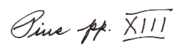
Pius, pp. XIII

Top of Page |
Pope's
Homepage |
 Email
Email
to Papal Secretary |
 |